Showing posts with label Leopard. Show all posts

November 26, 2015

Show Stoppers


EcoTraining is about the small things, we all know this, and we truly believe it.  The mechanisms evolved over millennia by the coexistence of organisms know no bounds:  the relationship between figs and their wasp pollinators, the unique adaptations of an ant-lion larva to locate its prey and the fascinating behaviour exhibited by the polyandrous African Jacana are just some of the majesties awaiting a potential student on one of our courses.  That being said, nothing beats witnessing interactions between Africa’s heavy hitters, the big cats!

It’s a bit like buying a car: we know that we should spend our money on a nice safe and reliable family car with good fuel economy, but most of us would give our right arm to own an Aston Martin or Bugatti!  There is just something about them. The cats are no different.  They are the aces up the sleeve of the bush poker player, and the Mecca for any safari-goer!

What happens in the bush under the cloak of darkness is a mystery to most, but occasionally the nocturnal exploits of these key players transcend the dawn and we are able to view some unique events unfold.  Lions and leopards are mortal enemies.  Countless generations have fought this war; a war where both sides have their special weapons.  The lions have strength both in physicality and in numbers, but what the leopard lacks in this department it makes up with guile, agility and stealth.  Both will kill each other, especially their offspring, and most young cubs succumb to predation by one of their carnivorous cousins.

For a mother leopard nurturing a cub, a run-in with lions usually spells curtains, but lighting reactions and unparalleled tree climbing abilities might just be enough to save them.  By the time we arrived at the sighting, we found a majestic leopardess patrolling the treetops whilst her nemeses circled below.  Her footing was sure, and she almost mocked the comical attempts of the young lions far below her as they tried to scale the vertical trunk to reach her.  She spat and growled, but knew better than to antagonize her much larger relatives.  Her lightweight frame allowed her to control the canopy, but youth knows no bounds, and time and time again, the young lions tried their luck.  This made for some great viewing as their facial expressions matched their frustrations as their powerful limbs were nullified by their greater body mass and weak wrists.  Failed attempts ended in a shower of bark and a somewhat unceremonious dismount!  As usual, it is difficult not to anthropomorphasize the events, but if a lion could ever look embarrassed, this was it!

The leopardess however seemed distracted.  Between bouts of snarling at her feline foes, she continued glancing skyward towards a nearby fig tree.  Upon closer inspection we discovered a small cub, no more than 6 months old, sheltering in the upper reaches of its arboreal safe haven.  Whilst we could hear no communication, their glances spoke a thousand words, the maternal bond felt by both easily bridging the gap between their refuges.  Leopard cubs learn to climb from an early age, and this skill can save their life.  Despite balancing 10m from the ground, the cub looked sure-footed, relaxed and it matched its mother’s aggression towards its pursuers with low growls that defied its size.  Not that the lions were too concerned. However, despite several attempts, the lions knew they were beaten.  Disdainfully they relinquished their spot on the battlefield, slinking silently into the surrounding bush as the heat of the Sun sapped their resolve. 

The leopardess and her prodigy remained in their lofty sanctuary watching the retreat of their antagonists until the coast was clear.  The female gracefully dismounted and moved to the shade of a nearby termite mound but her terrified cub remained aloft.  This female is not very relaxed around cars and whilst their ordeal was over, our ethics dictated that we leave the area to allow mother and cub to reunite and disappear back into the bush in the way that only leopards can. 

It was an epic sighting for us, but just another day in the endless struggle for survival of one of Africa’s greatest icons.  The small things in the bush are fascinating, more so than many of you might realize, but some things are truly special.  We all have our weaknesses, our addictions if you will, and mine is the leopard. To see a mother and cub in a tree, and the interactions of hungry lions below them is as good as it gets!

Blogpost and photos by Ben Coley

February 19, 2015

Life's a Journey, not a destination

Commuting is a word that fills most people with dread.  All too often in the big cities, a commute means leaving early to try and avoid the inevitable traffic.  Invariably this fails and first experience of your day involves sitting in a line of cars becoming increasingly frustrated and inhaling a vile concoction of fumes.  All this to finally arrive at a dull office and mountain of paperwork that will consume you for the next 8 hours before facing the equally unpleasant return journey.

A 7 hour trip lay before me as my engine spluttered to life in conjunction with the Sun’s first appearance of the day.  As an instructor for EcoTraining, it is often necessary to head to one of our other campuses and today my destination was Makuleke in the remote north of Kruger.  In order  to avoid the current political squabbling in some of the townships, my route would take me to Phalaborwa gate and then a further 300kms north through the park.  Despite the length of the trip, I was excited – it has been a long time since I had driven through Kruger and while most of you would be sitting in your cars listening to morning radio, trying to quell the onset of road rage as another taxi cut you off, I would be meandering through 9000 square kilometers of game rich wilderness.


When we embark on a trip, the highlight is usually the destination.  This is because the trip to get there is often a rather uninspiring affair but, as I entered the park gates, I knew that this journey would be full of surprises.  A ribbon of tarmac snaked its way northward through the lush bush, the vegetation revelling in the in recent rains.  With not another road user in sight I set off with that familiar feeling of the anticipation of what would be around the next bend.  Perhaps 50kms from Phalaborwa I met a car by the side of the road, its occupants beaming and pointing eagerly at a majestic jackelberry tree close by.  They beckoned for me join them.  In the real world, how many of you would stop for a car parked randomly at the side of the road.  Experience and negative media has conditioned us to avoid this situation and I think most of us would avoid eye contact and continue.

This is Kruger.  It is a different world.  A world whose visitors share a common passion: that of nature in all its glory.  Road users in Kruger are usually only too happy to share their encounters and I pulled in behind them I saw what had them so excited.  40m into the bush, a leopard lay draped over a branch in the dappled light.  It looked like a piece of gold and black velvet as its muscular body hugged the contours of the limb.  Its lazy eyes watched us without concern for a few minutes before deciding that more solace could be found elsewhere, rose, stretched and gracefully dismounted from its perch.  Within seconds, its sleek form has vanished into the undergrowth and I was left with only a few photos as evidence the encounter ever happened…
Leopard draped over a branch in the Kruger National Park
This was undoubtedly the highlight of my trip but for the next 5 hours I bumbled through the heart of the Kruger.  My progress was controlled by me – no unexplained hold-ups, no dare-devil pedestrians, no reckless drivers, no smell of fumes and no traffic lights (although an elephant standing in the road has a similar effect!)  Occasionally I stopped to share in the delight of the frolicking impala lambs and the revel in the splendour of a vibrant European bee-eater as it scanned the roadside for an easy meal.  The mopani trees in the area had attracted a multitude of elephants and I was graced with multiple sightings of these gentle giants pruning the roadside vegetation, as well a 400 strong herd of buffalo, meandering its way to a waterhole to quench their thirst.  Perched atop one of these bush battering rams was a rare yellow-billed oxpecker!

Elephants next to road
Where else in the world could a drive to work be so enthralling.  To make those of you reading this from your office even more jealous, what lay ahead for me was 23,000 hectares of pristine wilderness and a week of walking within it.  Officially this constitutes work in my world but the word ‘work’ has such negative connotations.  It conjures up visions of toil and hardship, performing mundane tasks to which your involvement often bears little or no relevance.  During the next week I spent close to 50 hours on foot in nature’s playground.  I viewed both elephant and buffalo on foot, swam in natural springs and fell asleep to the haunting whoop of nearby hyaenas under a blanket of twinkling stars, the likes of which city-folk will never experience.  Work is the wrong word for this! 

Yellow-billed Oxpecker
Either way, my return journey was just as exhilarating.  What an honour to be able to travel to and from ‘work’ along such adventurous paths.  The destination was magnificent, make no mistake, but the road to get there was just as pleasurable.  We are graced to live alongside such areas of natural beauty, where every moment spent within it is precious. 

Blog and photos by Ben Coley


October 21, 2014

A day full of surprises at Mashatu

Mashatu Game Reserve is home to the Mapungubwe rock, also known as Leeukop. It is believed that local Botswana chiefs were buried on this rock and that they are related to Botswana’s President. No one is allowed to climb this rock unless you ask permission from the President.

Okwa (Assistant instructor at Mashatu camp) “We were on our way to collect the students who was about to start the Safari Guide course at our Mashatu camp, when we witnessed a leopard on the road close to Mapungubwe rock also known as Leeukop rock.  This was only the beginning of sighting about to follow.

The following morning we left camp for a walk. As we started walking we heard vervet monkeys alarming. We decided to use the game drive vehicle instead of walking so that we can investigate what caused the alarm. At first we did not come across anything, and then we decided to start walking again. Not even 5 minutes later we found fresh leopard tracks on the ground and followed the tracks for about an hour before it disappeared into thick bushes and had to give up on the search.

We then went onto a ridge where we saw some elephants and decided to approach them. Everything was in our favour, from the wind to the escape route. We came as close as 100m from the elephants and enjoyed the sighting of a breeding herd from a distance.

Thereafter we heard rock hyrax alarming on Mapungubwe ridge. It could have been either be an eagle or a predator, so we went investigating. As we walked around the corner one of the students noticed the tail of a leopard, approximately 70m from us. We backed away to a safe distance where the students could admire and take photos of this magnificent animal.

This was an amazing sighting for all of us. It was an eventful day filled with great encounters “.


May 27, 2014

Sundowner Surprise at Karongwe

We were nearing the end of the Level 1 55 day course at Karongwe Camp and
as is usually the case at this time in the course the students, who were now
preparing for their practical assessments, were now starting to explore the
area for a suitable route for each of their assessments whilst brushing up
on a few of their guiding skills. We left camp in the late afternoon and
wound our way through the woodland north of Camp towards an area known as
Beacon Rock. On the way, our "guide for the day", Katarina, stopped to point
out many interesting birds, flowers, trees and animal tracks from the game
drive vehicle.
Katarina had asked each of her guests, before leaving camp, what animal or
interest they had, and for one of the few times during the course, nobody
said "Leopard"!
One of the vehicles driving from a commercial camp in the reserve had found
a 3 Cheetahs in the direction we were headed, but Katarina and the group
decided to avoid the sighting and stick to the original plan of reaching
Beacon Rock for sundowners!!
Whilst winding our way down a road, having a small competition of "who can
identify that tree" as one tends to do from time to time on these courses,
thankfully our guide had her eyes on the road and when the vehicle came to
an abrupt stop, we all looked to the road to see what had caused the sudden
halt!
There in the road no more than 50 meters from the vehicle was a magnificent
female Leopard. She stopped for a few seconds to look at us, and then to
everyone's amazement, she just continued walking straight towards the
vehicle.
Straight away, we noticed that one of her eyes was darker in colour and in
fact was all "cloudy" in appearance. I have seen this a few times over the
years in big cats and in nearly all the cases I have witnessed, it was from
a bad injury to the eye that could have been caused by a claw of another
Leopard whilst fighting, an antelope's hoof to the eye or another such
injury. The amazing thing is that it doesn’t seem to impede the cat's in any
serious way from carrying out their day to day functions. One Leopard I
followed lived over 10 years after sustaining such an injury and
successfully raised a few litters of cubs in the process!
Anyway, back to the leopard in the road!! Just a few meters short of the
vehicle she moved into the bush to allow herself some breathing space before
returning to the road and resuming her march, stopping once in a while to
elegantly scent mark her territory with urine.
We followed at a distance that she was comfortable with for about 600meters,
before she decided to head off the road and into the open woodland. This
was a perfect opportunity for our guide to get some off road driving practice
in!!
We followed her watching her movements to predict the best route for the
Land Rover to take, avoiding all trees, such as Sickle Bush whose large hard
spines will deflate a tyre as quick as a six inch nail!! After about 100
meters into the bush, the Leopard stopped and put her nose into the air and
sniffed once. She then let out a vocalization that safari guides live for. A
short grunt followed by a few loud sniff like noises, then repeated them. I
quickly explained to the group, that what she had done, was to try contact
another Leopard at close quarters, possibly and hopefully young.
She called a once more and moved slightly deeper into the bush, where we
lost sight of her for a second. The anticipation and excitement on the
vehicle was electric, and we after repositioning the vehicle we saw what we
were hoping for. A Leopard cub bounded out of the grass to greet its mother,
and we watched as the two played and groomed.
After having enjoyed the Leopards for nearly an hour, we left them moving
into thick bush too thick for a Land Rover to follow, but we had all had a
fantastic time watching and learning about Leopards.
So next time your Safari Guide asks you your interest before a drive,
perhaps, Trees or Birds should be your response!?


Photos supplied by Joep


September 26, 2012

BE ONE WITH NATURE: MASHATU CONSERVATION AND RESEARCH COURSE, 13-25 NOVEMBER 2012 (BOTSWANA)


Take a moment, and picture this…

Following in the footsteps of the largest herd of free roaming elephant on private land, picking up the spoor of lions, leopards, spotted hyenas, bat eared foxes, aardwolves, cheetahs, and at night with the help of a spotlight scouring the plains for a glimpse of night dwellers like porcupines, aardvarks, genets and civets.

If you want to join in an unrivalled adventure experience of this nature, then book a place on the EcoTraining conservation and research course at our Mashatu wilderness camp in Botswana. For 14 days you will roam this massive tract of land in the easternmost corner of Botswana, the ideal terrain to appreciate the wild.

And this is what you will get to experience, among other things. Feast your eyes...


This course offers you the opportunity to join a dedicated research project in a new approach to game management. This exciting new concept in wildlife management creates a need for volunteers to assist in research of populations moving through this vast wilderness. Educational modules will be included in the form of lectures and daily drives and walks, projects and reserve work. Link in with researchers in the area and help collect data and share knowledge of the area.

More scenes from life at Mashatu...


It’s all about the bush. So as is the case with our other camps, the Mashatu camp is unfenced, and animals do on occasion wander through. Therefore don’t be surprised to wake up and find elephant, leopard or lion tracks around the camp.

Make 2012 a memorable year, give yourself an early Christmas present and book your place on the course running from 13-25 November! For more information and bookings, email enquiries@ecotraining.co.za or visit www.ecotraining. 

August 6, 2012

NEWSLETTER: AUGUST 2012


 "Although human ingenuity may devise various inventions which, by the help of various instruments, answer to one and the same purpose, yet will never discover any inventions more beautiful, more simple or more practical than those of nature... " (Leonardo da Vinci)

Spring is in the air! Well, almost… And by all accounts it’s going to be a hot and sizzling time counting down to the end of 2012. The call of the African wilderness is louder than ever and EcoTraining is ready with an array of courses to suit all preferences – from the more serious that wish to enter the guiding industry on a full time basis to discerning nature lovers. Have a look what is coming up, courses on offer, what we’ve been up to so far and other interesting snippets.

WHAT’S COMING UP
If you have the urge to make a break and head for the bush, get yourself a place on one of the following EcoTraining short courses on offer in the next couple of months. Come on, you won’t regret it:

10 September – 7 October: Trails Guide – Makuleke: Explore the wilderness of this part of the Kruger National Park on foot where the majority of time will be spent conducting bush walks in big game country. It is open to anyone who wants to experience walking in a true wilderness area, while at the same time increasing your environmental knowledge and situational awareness.

20-26 September: Birding – Mashatu: For all the birding enthusiasts, this is a very practical course, designed to broaden and enrich your knowledge and skills by educating you about the fascinating world of birds and the interdependent relationships between them and other life forms.

27 September – 3 October: Tracking – Mashatu: To unravel the mysteries of nature even further, book a place on a unique seven day tracking course with EcoTraining and some of the most highly qualified trackers and trainers in South Africa. It is fun. It is hands on. It is life changing!

16 October – 8 December: 55 Day FGASA Level One – Karongwe/Selati: This one is if you intend to enter the guiding industry as field guide or if you’ve chosen a professional career linked to wildlife or nature. Every minute will be a learning experience, being constantly exposed to the bush.


LATEST NEWS
Camps: Every minute on one of our courses in our camps in South Africa, Botswana and Kenya is a learning experience, being constantly exposed to the bush. See what the guys and girls have been up to in the past month!

Selati: Albeit on the smaller side of the scale, they have a reputation as fearsome animals, not scared at all of taking on much bigger opponents. "They" are of course honey badgers. These little rascals have reputation of getting up to lots of mischief when everybody is asleep and supposedly not watching... Luckily a group of students at EcoTraining's wilderness camp at Selati decided to have a late night around the fire recently and had their cameras ready to capture the culprit red handed!


Karongwe: Nature is about all things wild and wonderful and about so much more than just the big and hairies. But let's face it, if any member of the Big Five is putting in an appearance, the nobody is going to say no, not the least a participant on an EcoTraining course! Just ask Candice Wagener, a one year professional field guide student: 
"It was a long day of studying and then the GVI guys (volunteer project also based at Karongwe) started going mad on the radio about ingala being in the area. So we decided to go for a drive and see if we can spot these lions ...


As we turned the corner, there they were, the two lions, Sorro and Lisa. We parked close by and watched them, all the while still keeping the bird list ticking. Then Dale says 'By the way, did you see the other two lions over there?' Heads turned, one was lying in the grass and the other walked out of a ditch. And then a fifth one made an appearance. Sorro and Lisa did their thing (some mating) and then Sorro didn't want his female companion to join the rest of the gang, proceeding with chasing one of the young boys off. It was the most amazing thing! Africa's big cats let us tag along on their afternoon agenda, fantastic!"

This was just the start of an amazing month at Karongwe. Camp coordinator Olga and student Martin Hooijenga sent through this exciting update recently:
“It’s day eight and we had a week of amazing sightings that gave our group already the status as the ‘Lucky Group’. Just listen to this – day two we Zero, the big male lion, with two females; day three the hyenas with the babies; day five a jawless but massive rock python. Day six and seven passed without anything spectacular, so thankfully all was back to ‘normal' for our lucky group on day eight…


Then, as quick as a flash, a leopard leapt into the reeds! I thought I was dreaming, too eager to see a leopard again, but seeing the response of the students I was clearly not… It was amazing! Shortly after we heard an elephant trumpeting from the same direction, apparently harassed by the leopard and trying to chase it away. That worked as the leopard jumped again, now out of the reeds into our direction but swiftly disappeared into the grass again…
Just as we crossed Spectra crossing, Scar, a male leopard, appeared, barely three metres from the vehicle, looking at us, a little bit disturbed but overall relaxed. We couldn’t believe our eyes! Like a real gentleman he posed a bit for the cameras and then lied down a bit further off. 
It sounded like we were photographing some movie star with shutters going off left, right and centre, click-click-click-click! A little later Scar moved off between the reeds and we proceeded on our way back to camp, full of excitement!
... We cheered to the ending of another great day in the bush!”


Makuleke: Our camp in this concession in the northern most part of the Kruger National Park is living up to its reputation as a true African wilderness with lots of exciting encounters. The courses are packed with excited students chomping at the bits to log their hours walking amidst the famed fever tree forest. Pretty spectacular!

Erindi Game Reserve (Namibia): EcoTraining has landed in Namibia! As part of our commitment to guiding excellence all through Africa, we have struck up various partnerships to improve the skills and knowledge of field guides. And now the guiding community in Namibia is part of this and benefiting from the years of experience that EcoTraining has in the industry. Ralph Kirsten is the instructor and MJ Kirsten the camp coordinator for the current course being run in the Erindi Game Reserve. 


Mashatu (Botswana): Communication with our camp on the other side of the border is not always the easiest. Go to EcoTraining – Ecotourism specials on Facebook, like the page and you will see what’s been happening in the Land of Giants.


“MEET YOU IN THE BUSH”
For almost two decades now EcoTraining has been training field guides, starting way back in 1993 with the first batch of eager students attending the inaugural course in the Sabi Sands reserve in Mpumalanga. Since then a great number has gone on to make their mark in the industry and are continuing to do great work all over the world. We want to hear from you, email liryndej@hotmail.com with your stories!


CONTACT INFORMATION
Go and like our new official fan page on Facebook at EcoTraining – Ecotourism specials.
Also visit us on www.ecotraining.co.za and if you have any questions or queries, send an email to enquiries@ecotraining.co.za.

(Thank you to everybody who contributed with photos and information!)

May 4, 2012

Wildlife Photography - Photo Workshop

The workshop started off with the safe arrival of participants at Galago Camp in the northern Sabi Sands Game Reserve.   After settling in and a light lunch, we started off with a run-down on how the workshop would work followed by a discussion on the cameras and the various settings required to get the best wildlife photographs.
 With that sorted out we set off on our first game drive hoping to get some interesting subjects and little did we know how interesting it would become!

We hadn’t even left the area of the camp when I heard the single alarm bark of a baboon above the noise of the engine and immediately switched off to listen.  We heard the alarm bark again, but in the background we could hear very loud and urgent alarm snorts of a large herd of impala!  We raced across an open clearing and got to the impala herd which was staring fixedly in the direction of the woodland on the edge of the clearing.  We drove along the edge of the clearing expecting to see the leopard walking away from the impala through the woodland but saw nothing.  The impala kept staring into the same place and we repeatedly searched the area only to realise after the third try that the impala were actually looking into the long grass in the open no more than 10 metres from them.  We drove carefully in that direction and discovered an adult female leopard with a freshly-killed impala ram well-hidden in the grass.


We got ourselves into position to get as clear a view as possible and began to take photographs.  Five minutes later a single spotted hyaena came zig-zagging across the clearing and on picking up the smell of the kill, without any hesitation, simply ran in and grabbed the impala as the leopard scampered away.

We then spent the rest of the afternoon observing and photographing as the hyaena consumed the kill and the leopard lay patiently watching and waiting to pick up any scraps left behind has the hyaena dragged the kill away. 


Eventually, with its stomach bulging, the hyaena decided to stash the kill under a bush and wondered off and this gave the leopard a chance to get it back!  Surprisingly, she didn’t make any attempt to hoist the remains of the kill into a tree and simply settled down to eat.  A few minutes later the hyaena returned, chased the leopard up into a tree and ate some more.

We spent the rest of the evening watching as more and more hyaena arrived and the leopard rested in the tree watching her hard-earned meal disappear very quickly.

What an amazing start to the workshop with a lot of action which provided the photographers with great challenges.

That first afternoon set the tone for the rest of the weekend with sightings of another 5 different leopards, including a female leopard with her cub on another impala kill.  One evening was spent getting great flash photographs of the cub resting in a large monkey thorn tree as we learnt how to get correct exposures with flash and to use flash off-camera to cut down on red-eye.

Other highlights of the workshop included a great morning spent with 10 hyaenas in beautiful early morning light as they interacted with one another, early morning coffee next to a small group of hippos where we had the opportunity to get down on the ground and lie on our stomachs next to the water to get dramatic eye-level shots, a group of 5 white rhino who ended up walking so close to our vehicle that we were able to focus on close-up shots of their eyes, ears, horns and oxpeckers on their backs and a group of dwarf mongoose sitting on their termite mound basking in the early morning sun.


The early morning and afternoon activities were interspersed with lectures on various aspects of wildlife photography followed by the downloading of photographs from the previous activities for critique.


Hopefully the photographers left the workshop having learnt a few new things and inspired to go on to even better photography.  One thing’s for sure, we all came home with some magnificent photographs.

LEX HES - April 2012 EcoTraining Photography
Join our official fan page to see more of the amazing photographs taken on the recent EcoTraining wildlife photography course – Facebook Fan page link http://www.facebook.com/pages/EcoTraining-Ecotourism-specials/248905765170964

December 6, 2011

ECOTRAINING PHOTO WORKSHOP


ECOTRAINING PHOTO WORKSHOP
JAYDEES CAMP (18- 22 NOVEMBER 2011)
By Lex Hes

Temperature on arrival at the camp in the depths of the Timbavati was 38 degrees Celcius with high humidity, but this didn’t dampen the spirits of the 6 participants on this year’s photo workshop.

After settling in we served some tea and got straight down to business finding out more about each other’s photographic interests and discussing things such as white balance settings, ISO settings, image quality, over and under-exposure and the various other buttons and dials on the amazing technological wonder that is a digital camera.

With that completed we loaded up the game drive vehicle, two people for each row of seats and lots of camera gear.  As we set off, a message came over the radio that a young male leopard had been seen in the Shlaralumi River a few kilometers away.  We drove slowly in that direction, stopping regularly for photographic opportunities and when we got there found the young leopard resting on a dam wall.  We waited and after a while he got up and slowly began to move through the bush, providing us with wonderful sightings.  In particular, at one point, we were able to position the vehicle in such a way that the photographers were all close to eye-level with the leopard, which resulted in some great shots which showed the huge impact that is created by getting to eye-level with an animal.

Dinner around the camp-fire that night was extremely hot and humid and during the night a little bit of rain fell which cooled things down a bit.  Next morning, under an overcast sky, we left camp at 5-15 and a few minutes later Cecile spotted a large male African wild cat crouched in the grass.  He slunk off to a nearby bush and settled down in front of the bush in clear view and proceeded to groom himself. 

What followed was about 30 minutes of the best viewing that I have ever had of an African wild cat as he groomed himself, sat and looked around, stalked something and groomed himself again.  He eventually casually moved off towards the south.  The overcast conditions provided us with beautiful soft lighting and we all got great shots.

The soft lighting also helped with some good viewing of a group of spotted hyaena at their den.

Later that morning we saw an adult female leopard hunting through the woodland.  We were lucky enough to spend more than an hour with her as she tried to hunt impala until, as it got hot; she decided to rest in the branches of a tree.

After brunch we had an informal discussion about exposure followed by a rest period and time to download the results of the morning’s photography.  During afternoon tea we had a look at the results and discussed ways to improve our photos.

The afternoon game drive yielded a very relaxed breeding herd of elephants in the very late afternoon after the sun had gone down.  The low light was challenging for us all, but gave us the opportunity to experiment with high ISO settings and also with slow shutter speeds to create blurring effects.

On the morning of the 20th of November we got some good viewing of a pair of white rhinos which we followed for a while as they grazed peacefully.  At one point both rhinos stopped to defaecate and within minutes dung beetles began to arrive.  We waited for the rhinos to move away and then spent the next one-and-a-half hours with our lenses sticking into the dung heap trying to get photographs of the dung beetles doing their thing!  We watched them fly in, dig, create their balls, roll them away and then bury them.  This kind of photography is a completely different challenge and the results illustrated the importance of good depth-of-field in close-up photography.
In the afternoon we had some sightings of buffalo and also spent a successful late afternoon with the hyaenas at the den. 
The last full day of the workshop yielded an excellent sighting of a leopard resting in classical pose on the branch of an apple-leaf tree giving the photographers an opportunity to try many different angles and interpretations of the same subject as well as a great evening with a group of hyaenas at a waterhole, drinking, resting and hiding the leg of a buffalo in the water.  Before going back to camp we followed up on a pride of lions hunting through the woodland in the dark.
During the night the rain began to fall and continued to fall through the night and into the following morning.  We still went out and tried to get some shots of the rhinos in the rain, but the cold wet weather eventually sent us back to camp for a warm breakfast and departure.
For more information on the photography courses contact enquiries@ecotraining.co.za or visit our website at www.ecotraining.co.za

July 14, 2010

Leopard rescue


Tuesday the 23rd March was going to be a relaxed day before the new group’s arrival the next day. We had planned to put a pvc sheet over one of the new tents, and fix up a few things in camp to get it ready.

A call from our neighbours with a problem with the water pump gave us some excitement, and we headed out to help fix the water pump. On our way home we decided to see if the R36 river crossing was crossable, and proved that it was not. Once we had got ourselves out with the help of GVI’s new high-lift jack, we headed back to camp.

As we passed the junction with North-South main and East-West main Jaco spotted a leopard next to the road. I stopped the landrover so we could view the leopard. As she walked off we could see that the left-hand side of her face was extremely swollen.
We contacted the reserve warden, Kobus, and he came out to have a look before making a decision on what action to take. We baked in the sun for two hours while the leopard enjoyed the shade of a tree. Once Kobus arrived the leopard moved off, but we managed to keep track of her next to the road. She again settled down in the shade, leaving us in the sun again.
Kobus managed to get hold of the relevant landowners to get permission to call the local vet, Dr. Pete Rogers, and also to be able to put a collar on the leopard.
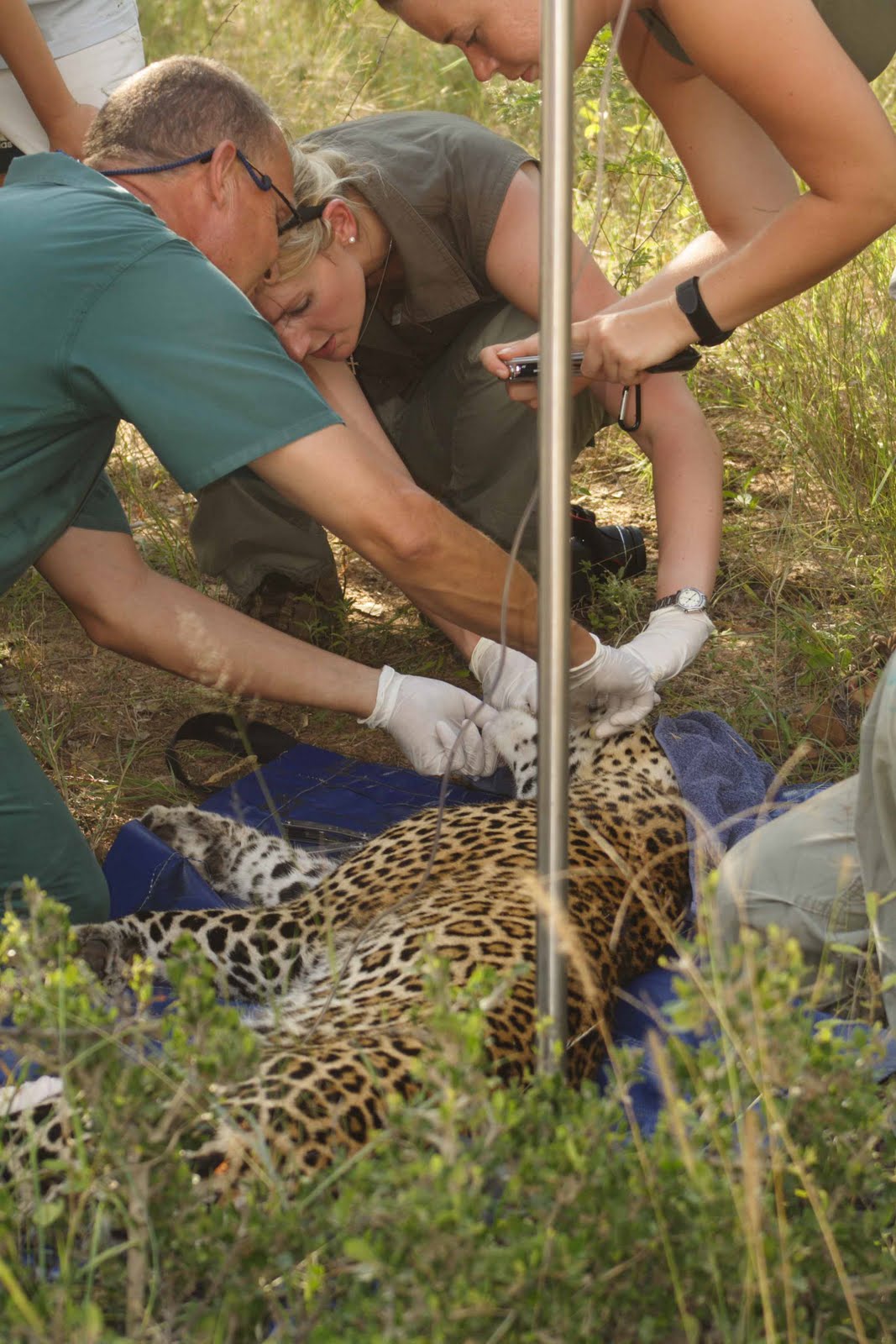
When Dr. Rogers arrived we collected him, and returned to the leopard. She was in thickish grass and we were worried that it would not be possible to dart her where she lay. Dr. Rogers took his opportunity and after we had determined how she was lying, he darted her in her shoulder. She took exception to this and after turning to ace us with a grunt, she dashed off into the bush, and out of our view.
Fortunately Kobus found her soon after that, and Jaco helped carry her back closer to the road so that Dr. Rogers could work on her.
She was still in good condition, but once Dr. Rogers had opened her mouth, it became apparent that there was something seriously wrong about her mouth. Two teeth and some other material came out of her mouth, and she was bleeding heavily from the area.
The prognosis is not good, the swelling seems to be due to a tumour, and Dr. Rogers took samples to have checked to see how serious the damage is. After stabilising the leopard Dr. Rogers administered the recovery drug, and after a few minutes she recovered and moved off from the road. Kobus had put a telemetry collar on her while she was asleep, so that we could monitor her progress.
The next morning Kobus provided an impala for her, to see if she could feed, and help her recovery.
There are always questions asked when it comes to taking an active part in assisting animals that are injured or in a bad way. Although we prefer not to interfere with nature, we have to consider that injured animals can often become problem animals as their ability to catch natural prey is reduced. Also within a small reserve such as Karongwe the relaxed individual animals in each population are our most valuable. It has taken us several years to get a female leopard habituated to vehicles in the south of the reserve, and to loose this animal now would set us back to where we were in the reserve five years ago.
We still need to hear from Dr. Rogers, if the sample collected indicates that the tumour is malignant, then we might be forced to put the leopard down before she becomes a danger to people in camps. We hope that she does recover, holding thumbs.