
 Posts
Posts


For the past week, the students at Karongwe
have undertaken an intensive tracking course that covered in excess of 50
different spoor, ranging from elephants to mice. Under the expert supervision of Lawrence and
Norman from the highly acclaimed Tracker Academy, the students have honed their
skills leave with a deeper understanding of one of the most ancient and
important arts that only an elite few have mastered.
Here are some top tips that have passed on
during the last fascinating week
· 1. Think Outside the Box’. Instructors will circle a solitary track in
the sand, but looking at one track is like reading one chapter of a book and
trying to understand the entire piece of literature. Animals leave a variety of tracks in
different substrates so it is always advisable to check up and down the path on
the chance that a better example can be found.
 |
| A solitary tracked circled by the instructor |
2. Get Up Close and
Personal’. Tracking is about
detail. The presence of a faint claw
mark might be the difference between an obscured African wildcat and civet
track. One cannot pick up enough
information from a standing position so get down on one knee, or even your
stomach, to ensure that every detail can be seen and taken into account!
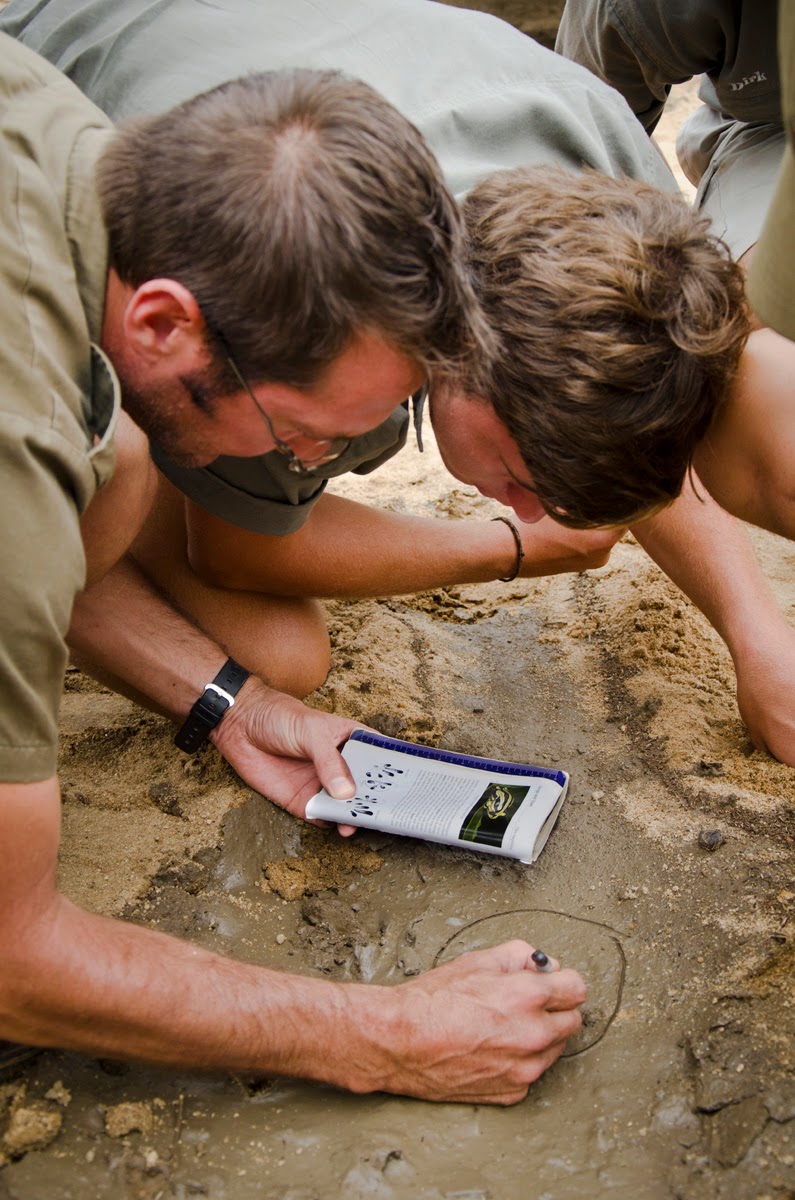 |
| Getting up close and personal |
· 3. Know Your Enemy’. Sometimes there is not enough discernible
information in the track to successfully identify the species. However, an in depth knowledge of its
behaviour and habitat can help you narrow down the selection. In a riverbed, a bushbuck track and grey
duiker track can be almost identical, but bushbucks love riverine vegetation
and thus chances are this will be the culprit!
· 4. Trust Your Gut’. With the amount of knowledge that has been
imparted of the past week, students often over think a track, trying to recall
every feature of every track they have learned.
However, this can be problematic and you can start to second guess
yourself. Whilst a thorough examination
of the evidence is important, your first impression is usually the correct one
and if in doubt, trust those instincts!
· 5 Weigh Up the Evidence’. Animals come in all shapes and sizes and will
walk on a variety of different substrates.
An impala will leave a very different track on a sandy road than it will
in the mud next to a waterhole. Hooves
will splay and soil will be more displaced as it sinks deeper into the
mud. Take this into account when
examining the track as logical thinking and knowledge of different soil types
just might help you decipher a tricky track!
 |
| Student looking to identify the track |
· 6. Pace Yourself’. The positioning of the left, right, front and
back feet can give you lots of information at the animal in question. The distance between the same 2 feet will
give you a reasonably accurate measurement of its body length (ie front right
foot to the next front right foot). You
can try this yourself: walk normally across the ground and then lie down with
your feet level with one track. The top
of your head will rest very close to the next register of the same foot. This can be vital in gathering enough
evidence upon which to base your identification of a particular track.
· 7. Take it in Your Stride’. The speed of the animal will dictate the
purity of the track that it left behind.
A slow walk will leave a much better impression in the substrate than
one moving at high speeds. A running
animal might slip and leave a more elongated track that, at first glance, might
lead your astray (refer to Facebook post from 8 April 2015)
· 8. Let There Be Light’. Tracks are best viewed at early morning or
late afternoon when the Sun is low in the sky.
The detail in the track is far more visible when contrast is available
thanks to light and shadow. In harsh
light, use your hand to create shade and play with the light available to
enhance any subtle nuances
 |
| Looking at the track from the right angle |
· 9. Line of Sight’. Viewing the track from the correct direction
is very important. Trying to identify
spoor whilst looking at it ‘upside down’ can confuse the brain and hinder you
from making the correct assumptions as to its design. Figure out direction first and look at the
track from behind to get a better feel of what may have walked there!
· 10. Go Toe to Toe’. Sometimes there is not enough information
contained in the track to identify a particular species but there may be a
repetitive pattern. Knowledge of the
natural rhythm, or gait, of an animal may help to narrow down your
options: does the track suggest bounding
or hopping, walking or running? The
simple arrangement, coupled with other evidence such as size might be enough to
reach a satisfactory conclusion!
 |
| Norman and Lawrence gives some information about the track found |


