December 10, 2015

Watch out...there is a hippo in the road.

Ben Coley with the hippo in the background

While out on a drive at Karongwe, the game drive vehicle came across a bit of an unexpected roadblock. Ben Coley describes the encounter in more detail.

"At the time of the detour, we were behind  elephants on the road so I tried to take a different road to get in front of them.  It had rained heavily in the morning and the reserve was dotted with puddles so I thought nothing of the pool of water ahead of us.  As my front wheels touched water, something moved.  We thought it was a terrapin until a huge shape loomed up, arched its neck and opened its mouth wide to reveal some formidable weaponry!  It turns out that this puddle was already occupied by a hippo!  I would like to thank the hippo for saving my blushes as without it causing me to stop, we would have no doubt become stuck as the ‘puddle’ must have been a meter deep!  Another great of example that in the bush, you never know what is around the next corner!"


November 26, 2015

Show Stoppers


EcoTraining is about the small things, we all know this, and we truly believe it.  The mechanisms evolved over millennia by the coexistence of organisms know no bounds:  the relationship between figs and their wasp pollinators, the unique adaptations of an ant-lion larva to locate its prey and the fascinating behaviour exhibited by the polyandrous African Jacana are just some of the majesties awaiting a potential student on one of our courses.  That being said, nothing beats witnessing interactions between Africa’s heavy hitters, the big cats!

It’s a bit like buying a car: we know that we should spend our money on a nice safe and reliable family car with good fuel economy, but most of us would give our right arm to own an Aston Martin or Bugatti!  There is just something about them. The cats are no different.  They are the aces up the sleeve of the bush poker player, and the Mecca for any safari-goer!

What happens in the bush under the cloak of darkness is a mystery to most, but occasionally the nocturnal exploits of these key players transcend the dawn and we are able to view some unique events unfold.  Lions and leopards are mortal enemies.  Countless generations have fought this war; a war where both sides have their special weapons.  The lions have strength both in physicality and in numbers, but what the leopard lacks in this department it makes up with guile, agility and stealth.  Both will kill each other, especially their offspring, and most young cubs succumb to predation by one of their carnivorous cousins.

For a mother leopard nurturing a cub, a run-in with lions usually spells curtains, but lighting reactions and unparalleled tree climbing abilities might just be enough to save them.  By the time we arrived at the sighting, we found a majestic leopardess patrolling the treetops whilst her nemeses circled below.  Her footing was sure, and she almost mocked the comical attempts of the young lions far below her as they tried to scale the vertical trunk to reach her.  She spat and growled, but knew better than to antagonize her much larger relatives.  Her lightweight frame allowed her to control the canopy, but youth knows no bounds, and time and time again, the young lions tried their luck.  This made for some great viewing as their facial expressions matched their frustrations as their powerful limbs were nullified by their greater body mass and weak wrists.  Failed attempts ended in a shower of bark and a somewhat unceremonious dismount!  As usual, it is difficult not to anthropomorphasize the events, but if a lion could ever look embarrassed, this was it!

The leopardess however seemed distracted.  Between bouts of snarling at her feline foes, she continued glancing skyward towards a nearby fig tree.  Upon closer inspection we discovered a small cub, no more than 6 months old, sheltering in the upper reaches of its arboreal safe haven.  Whilst we could hear no communication, their glances spoke a thousand words, the maternal bond felt by both easily bridging the gap between their refuges.  Leopard cubs learn to climb from an early age, and this skill can save their life.  Despite balancing 10m from the ground, the cub looked sure-footed, relaxed and it matched its mother’s aggression towards its pursuers with low growls that defied its size.  Not that the lions were too concerned. However, despite several attempts, the lions knew they were beaten.  Disdainfully they relinquished their spot on the battlefield, slinking silently into the surrounding bush as the heat of the Sun sapped their resolve. 

The leopardess and her prodigy remained in their lofty sanctuary watching the retreat of their antagonists until the coast was clear.  The female gracefully dismounted and moved to the shade of a nearby termite mound but her terrified cub remained aloft.  This female is not very relaxed around cars and whilst their ordeal was over, our ethics dictated that we leave the area to allow mother and cub to reunite and disappear back into the bush in the way that only leopards can. 

It was an epic sighting for us, but just another day in the endless struggle for survival of one of Africa’s greatest icons.  The small things in the bush are fascinating, more so than many of you might realize, but some things are truly special.  We all have our weaknesses, our addictions if you will, and mine is the leopard. To see a mother and cub in a tree, and the interactions of hungry lions below them is as good as it gets!

Blogpost and photos by Ben Coley

November 19, 2015

The day of the jackal

We at EcoTraining spend countless hours pouring over books written by a variety of experts to try and explain animal behaviour to prospective field guides.  We have a huge wealth of knowledge at our finger tips with which to glean the plethora of information documented on some of the most iconic animals in the world.  However, despite Man’s propensity of recording field data from observations, animals do not always read the text books and often we are made to look foolish as they defy the preconceptions we have attributed to them!

The other day, a report about a male lion that had killed a bush pig, came through on the radio.  We rushed to the scene of the crime already deep in explanation as to the feeding habits of Africa’s apex terrestrial predator, looking forward to watching the ferocious feline demolishing his prey.  When we arrived at the location we found the bushpig completely intact, not even opened, and no lion to be seen.  Often predators will kill other predators as a means of eliminating competition and these victims are usually not consumed as they were removed rather than killed for food, but there was no viable reason that a cache of meat such as this would be left alone.  It was a gentle reminder from the bush that no matter how long you spend out here watching the daily lives of its inhabitants, nothing is ever set in stone!

I can offer no satisfactory explanation as to why the lion chose to leave his prize but nothing is left to waste in the bush for long.  Throughout the afternoon, the vultures arrived and began to consume the carcass, comically scrapping and flapping around as they argued over feeding rights.  We returned to the site at the end of our night drive hoping that the smell of decomposing flesh had wafted its way to the sensitive nostrils of the resident hyena clan.  It seemed however that the hyenas’ had also turned their nose up at the meal but not so a small group of side-striped jackals!

This diminutive predator is often overlooked in the food chain but plays a hugely important role in cleaning up the bush.  It is not as gregarious as the more common black backed jackal and thus their presence was a welcome sight to us all.  The temptation of a free meal overrode their normal normally nervous disposition and we were rewarded with a wonderful sighting as they wrestled with their porky prize! 


Side striped jackals are omnivores and can get their water requirements from eating fruits which enable them to be very successful in more harsh terrains.  They are also efficient hunters and regularly take small mammals, birds and even arthropods but an unattended carcass was a bonanza for them to enjoy.  We stayed in the sighting long after dark enjoying their antics as individuals argued over the choice cuts, prompting a long discussion over their feeding habits, role in the ecosystem and why the lion chose to leave its kill. 


For me, the true beauty of working in the bush is the fact that nothing is ever set in stone.  For a lion to pass up an opportunity to feed is unusual, but its decision benefited a whole host of less powerful members of the bushveld community.  Rules are made to be broken and trying to fathom the rationale behind these incidents is what makes this vocation so fascinating.  Variety is the spice of life, and we bush folk live our lives wondering what awaits us around the next corner and it is this excitement: the unknown commodity, that makes a life in the bush so rewarding!

Blog and photos by Ben Coley

November 12, 2015

Tranquility


The bush is a place to find peace and solace.  The feeling of immersion in a pristine wilderness area is something that only a few of us are lucky enough to experience.  It is a place where the complications of our world disappear.  The sounds of never-ending traffic, police sirens and the constant hum of electricity are nowhere to be seen, and instead they are replaced by a myriad of tuneful birdcalls, an underlying cacophony of insect life, the whoop of a distant hyaena or the crack of a branch as a gentle leviathan feeds. 

The holistic effect of the bush is often overlooked.  People come to the wilderness to tick off their marquis animals and get their certificate of seeing the Big 5, but many will miss the true meaning of being lost in one of the world’s most pristine wildernesses.  It is a place to find ourselves, to revisit the primitive nature of our ancestors and experience what life used to be like before the advent of technology.  Undoubtedly our advances as a species have opened up doors to new places and allowed us to enjoy a more stress free life…or have they?  Yes, television and a comfy sofa sound like a great way to relax, but I can assure you all that it is no substitute for sitting next to a serene waterhole, watching the setting Sun‘s rays dance across the water.  The colours that seep through the skeletal winter trees cannot be put in words and I struggle to believe that even Dulux could recreate some of them. 

Our current crop of budding new field guides was privy to experience such an evening last night.  After a gentle walk from the camp, stopping to discuss an old hyena den and tasting the moisture-rich roots of the aptly named ‘Mother-in-Law’s Tongue’ we stumbled across an oasis.  Stretching out before us was a small body of water with no road access and thus protected from our own destructive influences.  The golden light of an African evening filtered through the clouds, giving the whole scene a magical hue: the trees seemed to radiate the light and shine it back at us like something out of a fairy tale.  Learning about the fascinating organisms that inhabit this area is one thing, but there is no substitute for just sitting quietly and contemplating life in such an idyllic place.

The students found their own quiet corner to just sit.  We spend our whole life rushing from one thing to another, governed by time and the need to attribute meaning to everything.  We have forgotten how to truly relax and find ourselves.  This was the perfect opportunity and we all relished in the chance to be wrapped up in our thoughts about why we chose to come to such a place, just appreciating the beauty and wonder of nature in her purest form.  We sipped drinks in the warm evening air and listened to the wind rustle the leaves and last of the birds say their farewell to another perfect day in Africa.  The only movement came from little pond-skaters skimming across the glassy surface of the water and the occasional bumbles rising from its depths as the unseen aquatic world went around its business.  It was a perfect moment where time was irrelevant.


This is what the bush is all about, and the reason that so many of us come to the bush.  We are all looking for something.  Some find it in a bustling city full of social interaction and technological advances.  Others, like myself, and many of the students who pass through EcoTraining’s welcoming doors need only experience this solitude once and become addicted to this purity.  The ‘real’ world can be fun, but only in small doses.  The bush gets under your skin and for some, it will change their life, and their outlook on it, forever.

Blog post and photos by Ben Coley

November 5, 2015

Ground beetles and bushveld lizzards

Beetles are one of the most successful orders on the planet thanks to a holometabolic (complete metamorphosis) lifecycle.  This means that the larva is completely different to the adult in both diet and habitat.  In order to reach adulthood, the larva must undergo pupation before emerging as a beetle (the same mechanism as butterflies and moths).  This theoretically enables them to double the number of individuals in a given area since the problem of competition for space and food is non-existent.  They have also evolved a plethora of anti-predation behaviour essential for survival!

Ground beetles display contrasting colours on their carapace to warn potential predators of their defence mechanisms.  This phenomenon is called aposematic colouration and is essential when their main predator, birds, rely on superb colour vision to hunt.  They are able to squirt a noxious substance at their attackers and are known to be very accurate giving rise to the Afrikaans name ‘oogpisters’ or ‘eye-pissers’!  In some species, the chemicals involved can even burn human flesh. 

Interestingly, there is a reptile found in Southern Africa known called the bushveld lizard that mimics the two-spotted ground beetle shown here.  The juvenile lizards show similar bright markings and even walk with a hunched, slow posture to try and dupe their avian predators.  It is one of the very few examples in nature where an arthropod is mimicked by another class of animals.

Blog written by Ben Coley
Photo courtesy of www.sareptiles.co.za 

October 29, 2015

10 fascinating facts about an elephant's trunk


1. There are over 40,000 muscles in an elephant’s trunk housing over 150,000 separate muscle fascicles (fibres that allow the muscle to move in various directions).  Humans have only 639 muscles in their entire body!

2. The trunk alone can lift close to 400kgs, yet is delicate enough to pick up a single piece of straw.

3. The trunk can hold over 20 litres of water which is why, despite their enormous water requirements (approx. 120 litres per day), elephants generally do not linger whilst drinking.

4. Elephants are able to use their trunk like a snorkel, easily crossing deep water totally submerged except for their trunk breaking the surface.

5. The trunk contains 5 times more smell receptors than humans, and twice as many as a bloodhound.  This enables them to smell water from miles away.

6. Such is their olfactory power that projects are training elephants to aid in clearing minefields in areas of Mozambique.

7. When faced with a particularly interesting smell (such a cow’s urine) an elephant will touch its trunk to the source of the odour and physically place it in the organ of Jacobson in its mouth for further analysis.

8. Elephants show a preference to one side of the trunk than the other, thus seeming right or left-handed.  This is most obvious during the wet summer months when one side of the trunk becomes stained green from repeatedly plucking grasses.

9. The tip of the trunk contains a layer of cells known as ‘Pacinian Corpuscles’ that are specialised in sensing vibrations.  This may be one of the mechanisms enabling elephants to communicate over such long distances using low frequency rumbles.

10. These low sounds are made possible as the trunk acts like a 2m long resonating chamber!


Blog and photos by Ben Coley

October 23, 2015

False sense of security


Elephants have long since been my favourite animal to view in the bush but the past three months have been a great test of my admiration towards them.  Living in the bush is an honour but wherever people and animals coexist, there will always be conflict.  Thanks to a very dry winter, water has become the most valuable commodity on Karongwe.  It is an essential requirement for almost every organism on this planet, and when under water stress, their will to survive is strong.  When the animal in question weighs over 6 tonnes, the outcome is inevitable…

For month after month, the local herd of elephants’ massive water requirements have reeked havoc on our bush oasis.  Elephants are fussy when it comes to water, and when faced with a stagnant pool of water versus the clean water in our tanks, there will only ever going to be one winner.  I soon learned that trying to stop or outsmart them was futile and it pains me to say but I had given up trying.  It had become routine to stockpile water in the evenings and then fix the pipes the next day.  We all had no choice but to accept it.

Finally last week however, the rains came.  Thunder and lightning ravaged the skies and the first downpour of the season was relished by all.  With water no longer in such short supply, the elephants relinquished their relentless raids on our tanks and seemed more content now that natural order had been restored.  We were lucky enough to bump into them the day after and they seemed filled with the joys of spring as they frolicked in one of the dams close by.  Despite my love for these gentle giants being tested to the full over the last few months, nothing could contain my grin as we had a perfect view of the herd splashing about, one even deciding that the occasion was worth a swim!  I am supposed to teach guides to interpret behaviour, but sometimes it needs no interpretation.  Joy is a powerful emotion and it positively oozed from these most emotive of animals.


The elephants moved north, back to the area they tend to spend the summer, and we let our guard down.  For days we enjoyed running water.  Showers seemed sweeter than ever and the simple pleasure of water on demand become common-place once more.  We may have lost the battle but we had won the war.  Battered and bruised yes, but we had weathered the elephantine storm!  The bush however is not without its sense of irony, and whilst I secretly celebrated the end of a long and arduous campaign against an unstoppable enemy, I was in for a rude awakening.  

I slept well that night under the soothing shroud of a false sense of security.  As the morning light filtered through my tent I went to help myself to a refreshing cup of water but when I turned the tap, I was met by nothing but the sound of rushing air (although I swear there was a subtle hint of elephant mockery mixed in with it!).  They had returned.  Like silent assassins in the night they had travelled the length of the reserve and reminded me who indeed was the biggest fish in this newly stocked pond.   Normal service had been resumed I was left with no question as to who had the upper hand in this long-running war!

Hopefully the summer has begun and the pressure on the animals will recede as more rains fall.  Either way, despite their destructive tendencies, they still remain my favourite animals.  Coexistence with nature is whole point and it is up to us to adapt and learn to live together in harmony.   One thing is for sure, whether they are causing mayhem at camp or delighting us with their aquatic antics at a more natural venue, the honour of living in the midst of giants is a true privilege.  

Blog post and photos by Ben Coley

October 9, 2015

Survival 101: What to do when you get lost in the bush

What do you do when things go wrong and you get lost while out in the bush? In a nutshell: Stop, stay calm and plan. Keep warm. Drink plenty of water and ration your food. Conserve your energy. 
Be determined to survive. Get help.

Actually there are a number of things, so let’s tackle this systematically.

The first and most important thing to do is to remain calm and THINK. Then make tea, tea and not coffee. Making tea requires a certain ceremony and if you can take your time and make tea, then you are in charge of the situation. Then take stock of your situation.  

The first option is to turn around and track yourself out of there. Your shoes have left marks on the trail; the tires of the vehicle have left two long lines behind the vehicle. The vehicle will not leave tracks on a tar road but if you are on a tar road then you are probably not lost.

If this still does not work then settle down and make a camp. Take out you little survival pack. What, don’t you have one? You should have packed it before the rest of your kit. Inside should be the following: a small bag or pouch with a lighter, some strong string, a knife and/or a machete; a small pot for cooking and boiling water; soap and a lightweight towel; water sterilizing tablets and coffee filters, to filter water not coffee; insect repellent; a proper first aid kit, not just a packet with first aid written on it.

The weather conditions will determine what type of protection you will need. Do a good job of keeping yourself warm and dry. Find and purify water or ration the water you have. Find fire-wood before it gets dark but use it sparingly. Have a pile of small sticks that you can throw on if there is a threat from animals. Feed the fire slowly, do not heap it up and then let it die down to almost nothing.

Stay near the vehicle if you are using one. The vehicle is easier to see than people on foot. You should have left a rout plan and return date with someone. Stick to the plan. Do not ever deviate from your plan. If you do not return by the set day then they will send people out to find you. You should know your equipment; know how to use it when it works properly as well as when it is not functioning properly. The boy scouts motto of “be prepared” says it all.

Look around you as you travel, look back at any junctions that you pass, see them from the return journey’s perspective. Learn to use your equipment properly and then practice regularly. Learn some skills and practice them regularly; learned skills are lighter to carry than a book. And very importantly – NEVER over-estimate your capabilities but be positive about what you can do.


Courtesy of EcoTraining instructor Mark Gunn - article written by Liryn de Jager

October 1, 2015

Top 10 tips on how to cope on an EcoTraining course

Being in a group setting isn't always easy, especially if you are surrounded by strange people in a brand new environment.  

We have asked a few of our former students to give some advise on how to cope with the training period, especially living in such a close community with fellow students. If you keep the below step in the back of your mind at all times, you will have an amazing time on course and walk away with a lifetime of memories. This is what they had to say:
  1. Be friendly and humble
  2. Take advise and set boundaries and know your boundaries and know when to give people space
  3. It can be tough. Especially at the start. So much to take in, but if you keep going and enjoy it, then everything comes naturally. As for the people you are with, whether you like them at the time or not, they become family!
  4. Work Hard and Take notes always! Do not leave any paperwork until the last minute.
  5. Focus on why you are here, and not everything else.
  6. Stay motivated and push through it. It is worth it in the end.
  7. Respect the instructors and fellow students and enjoy learning about every aspect of the bush.
  8. Get clarity on deliverables at the start of the course.
  9. Don’t get into the bottleneck of assessments.
  10. Try not to get involved in petty rows. Be patient.
The most important is to make the best of your time in the bush. Staying in camp, surrounded by nature 24/7 is a huge privilege that a lot of people have never experienced. Make every second count! 


September 24, 2015

What the students have to say: FGASA Level 1 course in Zimbabwe

EcoTraining in collaboration with Nakavango Conservation programme runs FGASA Level 1 courses from the Stanley and Livingstone reserve in Zimbabwe twice a year. This venue proofs to offer amazing learning opportunities and beautiful sightings. The current course started on 17 August, and are just about halfway through and with Mark Gunn as an instructor, you can only have an amazing time. One of the students shares her experience on the course thus far:

Ruth Westrick, Switzerland
"I just want to send you a quick note to let you know how much fun I have got doing the FGASA level 1 course at Nakavango. It is intense and I am thoroughly enjoying every aspect of it. We've had some awesome sightings where we could observe animals for a very long time, whilst learning a lot of interesting facts about everything that the bush is offering. Mark, our instructor has got an impressive knowledge and I like his holistic approach. I am sad to say that we are over half way already and will continue to enjoy my great time here.
Our short trip into Chobe was awesome as well. You are running a great programme and I am so glad that I enrolled for it."
For more information on the FGASA Level 1 course in Zimbabwe, contact our enquiries department at enquiries@ecotraining.co.za or call us +27 (0)13 752 2532

September 17, 2015

Chinese Whispers


EcoTraining is pioneering a new venture with partners in China to try and educate curious travellers in the delights of the natural world. We hope that by enlightening about 8 groups per year, hopefully some being potentially influential people, the knock-on effect may have a huge impact on the future of our once spacious and green planet.
The science of ‘conservation management’ is a fast growing discipline with new methods and ideas being tested continually. However, most of these ideas are reactive, trying to combat problems that are already rife.  To save our wilderness areas and their species, we need proactive measures.  The simplest of these measures is education, and more importantly, who is educated about the importance of the environment for our survival.   The root of our environmental crisis is the over-population of our fast-vanishing home. 
Asia is perceived by many to be the root of the population boom and thus a huge cause of habitat loss and over utilisation of natural resources as people use them to survive.  The continent itself holds two thirds of the world’s population!  A proactive measure therefore is to educate this vast population so that they understand what the relentless spread of Man is doing to our planet.  Using the bush as a natural catalyst to experience the wonders of the natural world will hopefully increase the chances of us all working together to save her.
The EcoTraining EcoQuest 7 day course is designed to immerse its participants in the wilderness and whilst time is limited, we try to cram in as much information as possible - concentrating specifically with reconnecting to nature, ecology and of course, conservation initiatives.  Activities are tailored around such topics as symbiotic relationships, ecological roles, poaching issues and survival, and the inter-relationships between all aspects of the ecosystem, especially our own.
The last Chinese EcoQuest students recently a week with EcoTraining at their Karongwe tented camp. What better classroom in the world?  Days were spent exploring the reserve and many great sightings were witnessed, including lions feeding on a giraffe kill and various encounters with white rhino.  Situations like these do not need much interpretation as the subject matters themselves speak volumes.  For many eastern visitors, rhino and lion are just words and pictures or are associated with medicinal resources. Transformation should take place as seeing is believing and nothing beats spending up close and personal time with these iconic beasts. 
Our focus is not only on giving them a taster of what may not be around for their children to experience, but also the essential roles they all play in maintaining the stability of this now fragile ecosystem. 
The best way to learn something and appreciate it fully to actively experience it, and this is where we exert much of our energy when educating people.  This last group’s senses were tantalized on a daily basis as they tasted the sweet leaves of the buffalo thorn, chewed the moisture rich roots of the aptly named mother in law’s tongue, sampled tea brewed from russet bushwillow samaras and attempted to make friction fires.  The latter exercise is always a favourite with young and old, and the addition of some children on the last course made for a moving experience as they delighted in their efforts.  Although we achieved smoke and a blackened baseplate, fire was not forthcoming despite the blisters on our hands! 
Making fire
The group exercise was enjoyed by all and their renewed fascination of how the bush can be sustainably used was incited further when Norman Chauke, a local Shangaan tracker and instructor, fashioned some traditional traps used by the tribes people to procure food in survival situations.  For demonstrative purposes rope was used but the group also learned about which trees and plants can provide fibrous material if nothing artificial is on hand.  Norman made perfectly clear that these traps should only be used when necessary: for a man to catch an antelope to feed his family is one thing, but the relentless capture of millions of animals to fuel an organisation’s financial gain, be it through nutritive demand or medicinal belief, is not condonable. 
Norman demonstrates how the snare works
Discussions also revolve around energy flows, symbiotic relations between them and other organisms but there is also time for reflection and tranquillity.  A favourite among many is to sleep out under the twinkling blanket of the night’s sky.  The world we live in is three dimensional and for people who spent their lives in a concrete jungle of office blocks, traffic, noise and pollution, many have never witnessed the infinite beauty of what lies above us all.  It is easy to lose yourself in the stars.  It is a time to let your imagination extend to the furthest reaches of the universe and to consider our insignificant role in eternity. 
Sleep out under the stars
Waking up to the beating heart of Africa as the cerise sun shows its face above the horizon is a primal experience and for many, can ignite the blue-touch paper of environmental awareness. We hope that by the end of this short exposure to the wonders of the natural world, the eyes of these ordinary people will open up to the extraordinary environment in which they live, one that they did not know existed.  We hope that when they return to their homeland, the experiences and knowledge gained will percolate through their social and business circles like a snowball rolling down a mountain. 
The whispers of a few can influence the many, and the whispers of many can influence the masses.  This has always been EcoTraining’s philosophy and with the current state of our fragile environment, we need all the buy-in that we can get.

Educational Game Drive
 Blog and photos by Ben Coley


August 7, 2015

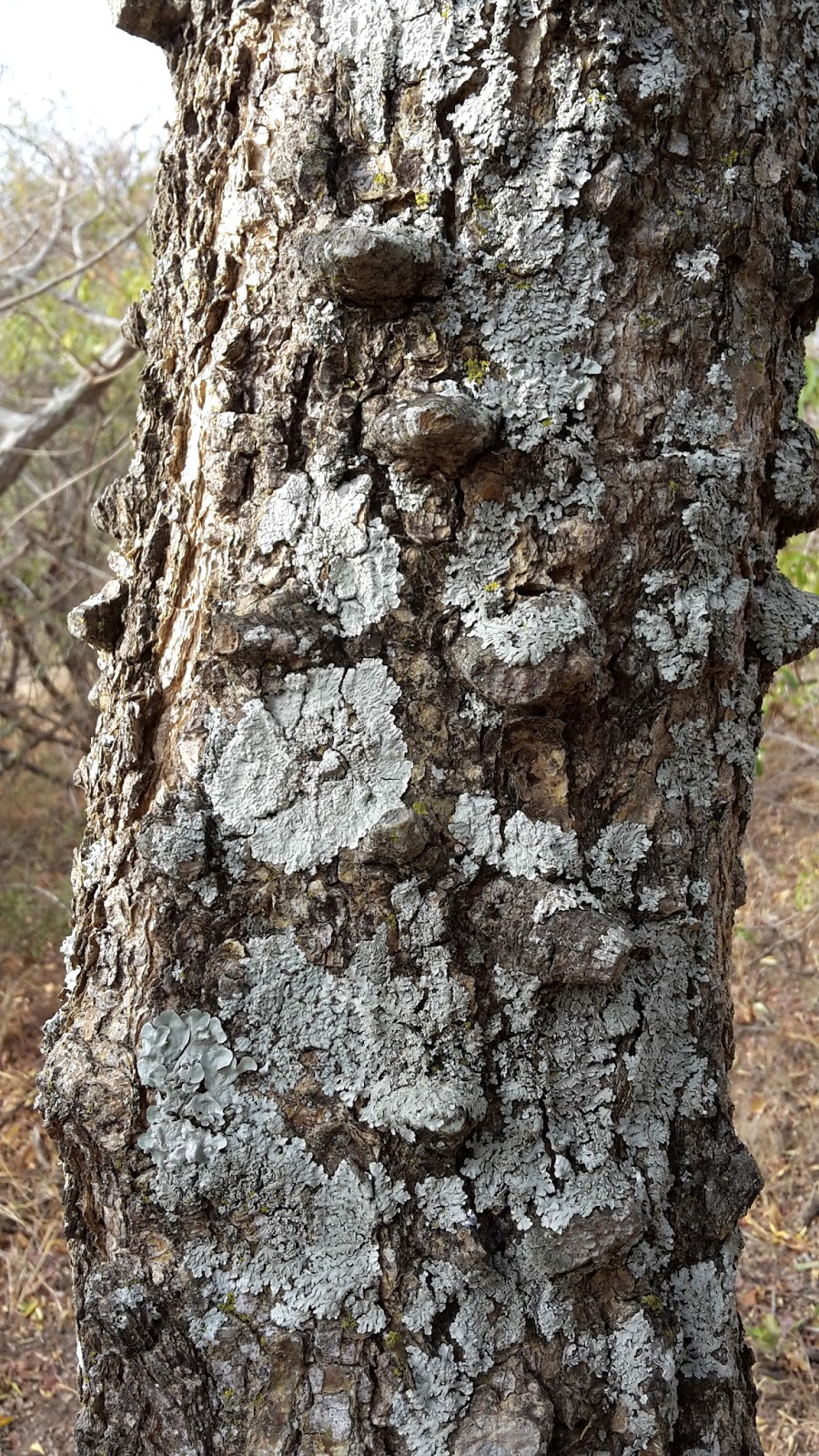
10 fascinating facts about Lichen (trust us, it more interesting than you may think!)

  1.          Lichen is made up of an algae and a fungus living in perfect harmony.  Each needs each other to survive and forms a symbiotic relationship known as ‘obligatory mutualism’.  Such is depth of this relationship that neither party can survive without the other.
  2.         The algae is an autotroph and can thus supply the organism with food produced by photosynthesis, whilst the fungus envelops the algae in order to protect it from desiccation and also provides it with a means to attach to the substrate.
  3.          If the algal and fungal elements of lichen are grown separately, their structures are completely different from that of their combined lichen form.  It seems that when placed together, the fungus envelops the algae to protect it from desiccation, among other things, and creates a completely new, symbiotic structure
  4.          Such is the success of this union, lichen species are abundant and inhabit habitats ranging from sea level to alpine regions, from the Arctic tundra to dry deserts.  In fact, lichen covers 6% of the entire surface of the planet and is considered to be amongst the oldest living things on Earth.
  5.          Lichen is considered an agent of mechanical and chemical weathering.  Whilst the process is exceptionally slow, it is still effective and is an important factor in producing soil over long periods of time.  Man-made structures can also be affected and the Mount Rushmore National Memorial in the USA has to be routinely cleaned by a group of mountain climbers to avoid irreparable damage being done!
  6.          Lichen grows very slowly but regularly depending on the species.  It grows at about 1mm a year and has been used as a technique to age exposed rocks, although it is only accurate up to about 1000 years of age.  It is particularly helpful in aging rocks of less than 500 years are carbon dating techniques are ineffectual at such young ages.
  7.          Lichens do not have a root system and thus get all of the nutrients they need from the atmosphere.  This means that they also absorb a variety of pollutants and many environmental studies with lichen emphasize their role as a feasible biomonitor of air quality
  8.          The pH indicators in the litmus test (to measure acidity and alkalinity) is extracted from the lichen Roccella tinctoria by boiling it
  9.          A selection of Lichen were exposed to the vacuum of space and the full force of the Sun’s radiation for a period of 15 days as passengers on a European Space Agency mission in 2009.  Amazingly, some species continued to grow as normal upon their return, fuelling interest from cosmetic companies looking to develop new sunscreens for human use.
  10.          With the search for new worlds to accommodate Mankind’s relentless population growth, some lichens were exposed to Martian atmospheric conditions in the lab for a period of over 3 weeks in 2012.  Amazingly, despite the weak atmospheric pressure, lack of protection from cosmic radiation, bitter cold and alien atmospheric composition, some species not only survived, but continued to grow and function with relative normality!  Evidence like this has given the scientific community renewed hope of find life on other planets!


Facts and photos by Ben Coley

August 6, 2015

Do a course that suits you best!

Mike Kirby has started off as a Professional Field Guide student earlier this year. Little did he know that he would end up working as a back-up guide at our camps during his Lodge placement programme. Mike shares some great insider tips to those who are not too sure about what course to book!

"Doing an EcoTraining short course, a 55 day FGASA Field Guide Level 1 course or even a one year Professional Field Guide course is, in my opinion, the best experience Southern Africa has to offer.
It caters for a complete African novice to guides who want to further their knowledge. EcoTraining has a course catered for you!
During my FGASA Level 1 training, you got to understand how the environment works around you, from mammals to arthropods to trees.  Your knowledge and general understanding of nature in Southern Africa and any other place will grow tremendously.
I would also highly recommend the 7 or 14 day Tracking course, held in one of the four wilderness camps in South Africa and Botswana.  I was astounded at how much this course taught me and how much I can apply the knowledge and read the ‘stories in the sand’.
If you only have a month to spare, then 28 day Trails Guide course is on the top of my list.  You will be ttaying in the remote wilderness camps of either Makuleke, Kruger National Park or Mashatu, Botswana. The art of guiding on foot is learnt, as well as accessing places that no vehicle or tourist has even seen.
All of the courses can be done without pursuing a career in guiding. You can look at it as an educational holiday in some of the best areas Africa has to offer.
Personal highlights during the One year PFG course was: 
  •           The remoteness of all the camps
  •          Walking with elephant and lion
  •          Opening my eyes to the little things that are quite often overlooked
The more you know, the more you appreciate nature and are breath-taken by what is going on around you in any environment."

Blog written by Mike Kirby


August 3, 2015

SA’s leading Guide Training company acquires influential FGASA CEO

Grant Hine
EcoTraining, the oldest and most established of the safari guide and wildlife training institutions endorsed by FGASA, is thrilled to announce the appointment of their new General Manager, Grant Hine. Grant is the former CEO of The Field Guide Association of southern Africa so this amalgamation of experience and skill from both parties should prove to be a noteworthy boost to the safari circuit.
The appointment comes at a time when EcoTraining has significant intentions to reach new places and new heights. “We are building a dream team to bolster EcoTraining into a position of having an impact on the world’s natural places,” says Anton Lategan, director and owner of EcoTraining. “We aim to win over the hearts and minds of people all over the globe and encourage them to love and care for their environment. Our life-changing wilderness experiences on all of our courses connect participants to the earth, reawakening instinctive senses.”
EcoTraining’s mission is two-fold: to produce highly qualified local field guides for the ecotourism industry, and to educate travellers from all walks of life about wildlife and ecosystems through a unique learning safari. What better way to achieve the aforementioned mission than under the auspices of Grant Hine, the guru in Field Guide Training in South Africa. Grant worked as a field guide and lodge manager for 12 years at various prominent safari lodges including MalaMala, SabiSabi and at lodges in the Lapalala wilderness area. His knowledge and experience with the etiquette of guiding guests into the bush to reveal fascinating facts about wildlife to them, ensured the move to become FGASA’s CEO was seamless.  Over the past 14 years, Grant has been instrumental in building up FGASA to where it is today and developing the existing guiding qualifications.
Trainers have challenging jobs as they host, teach, care for, understand, empathise and lead learners for long periods at a time. What they teach has a direct effect on how future safari guides behave, which in turn has a direct effect on international and local safari guests’ experiences and impressions of that particular lodge, game reserve, country and continent. Guides influence the hearts and minds of the well-travelled world. The responsibility of our trainers is significant as they are the messengers to a global audience.
After 22 years of guide training excellence delivered in the Kruger Park, Botswana, Zimbabwe, Kenya and further afield, the inclusion of Grant to the EcoTraining team will further empower EcoTraining to deliver the best guide training and the most powerful wilderness experiences to all who seek them.

July 30, 2015

Tracking - an unforgettable experience

If you ever thought of joining a Tracking course, then this testimonial will surely persuade you to sign up! Terry Black joined EcoTraining on a recent Tracking course and sent us the most rewarding feedback:

"I very much enjoyed my time in Makuleke, I'd been travelling through East Africa for two months before arriving in South Africa, but I think my time with EcoTraining was probably the highlight of the whole trip - and you can tell Alex that I think Norman was a very important part in making that the case.

We identified and looked at nearly 100 different species over the two weeks, and many more signs if you include spoor/scenting etc, and despite this vast amount of information coming right at us, it was absorbed very easily thanks to the perfect pace of the instruction and the fact that we were having fun every minute of the day.


Norman was an exemplary instructor. I honestly couldn't praise him highly enough. I have no criticism or suggestions whatsoever. He was very keen to ensure we were learning what we wanted to learn, asking early on if we had any other interests in addition to the tracks (medicinal use of trees, bird calls etc), and he was very conscious to make sure that everyone was OK all the time; asking 'Everyone still, OK?', whenever on a long drive or walk. I felt safe, valued and important at every step. His tone, pace, (and patience!) made the learning experience easy and fun, but it was his unbridled enthusiasm that was absolutely infectious. His charisma and love for the bush was plain to see and made the whole two weeks an unforgettable experience. I'm enjoying his 'after-care' as well (emailing me pictures of tracks to identify) and I hope I will see him again next time I'm in South Africa, I felt like I made a good friend.
Norman Chauke in action
Walking in the wild outdoors
The other EcoTraining instructors were all absolutely relaxed in their approach and professional in their execution. I would like to make special mention of Alan, who brought another dimension of expertise and experience to the course - it isn't just the stuff on the 'tracking syllabus' which informed my time in the bush, but every anecdote and story of the flora and fauna, history, culture, geology, ecosystems and daily life, and I owe Alan a great deal for enriching the experience.
Elephant encounter a few meters away

I felt honoured to have met Alex when he came to visit the first few days. I had very high expectations from the Tracker Academy and EcoTraining, and I am very pleased to say they were all highly surpassed. The work of the Tracker Academy is fantastic, Norman is an incredible ambassador for both The Tracking Academy and EcoTraining. I will be telling everyone I know about the course. I can't thank you enough."

The next 14 day Tracking course starts 10 August in the magical Botswana. Contact us at enquiries@ecotraining.co.za for to book your spot today!

July 27, 2015

Community spirit

Rarely in this day and age does a sequel top the first instalment, but a mere 2 weeks after the local school received a much needed lick of paint, the peaceful community of The Oaks was about to be shattered by a second rank of young, enthusiastic Americans.  Moondance had returned, and this time, with a vengeance.  Armed with nearly 200 litres of excessively bright and vibrant paint, the group surveyed its target: a 46 meter long stretch of marketplace; the focal point of the village.  The stakes had been raised and the pressure was on!
Marketplace before...
Youth however knows no fear, and within minutes of our arrival, the façade of the building was under constant assault from flailing rollers and brushes.  The relentlessness of the attack soon brought the local residents to the scene, and before long, both young and old were helping us apply the initial layer of primer.  The entire expanse of market front was primed in less than 2 hours and after a brief stop to stock up on caffeine, the group (and in fact, the community) wasted no time in applying the colour.  With over 20 market stalls to liven up, the decision was made to adorn each in a repeating sequence of colour to rival that of the ripe fruit shining from their displays!  The market owners had also arrived by now with most of the women ecstatic with the new look and each took great pride in helping spruce up their livelihood!
Getting down and dirty
Who says you can't have fun while working?
Some owners joined in
With all the help at our disposal, the kids had more time to do what kids do best, and before long, their once clean clothes, not to mention any available exposed flesh, were transformed into a cacophony of colour that would rival the tie dye phenomenon of the swinging sixties!  It also allowed time for them to immerse themselves into the community and the whole scene was lit up with the infectious laughter and smiles of small children as they learnt new games ranging from ‘Simon Says’ to ‘Ninja’.  The day had taken on a carnival atmosphere.  It was a perfect cross section of the community, and for hours on end, all language and racial barriers were destroyed by the endearing innocence of youth.
Having some fun with some of the children from the community
Despite the best efforts of everybody involved, the massive project could not be finished in a day and by sunset it was time to pack up and head home for a well-earned shower before returning the following day to apply the finishing touches.

With the pressure off after a very productive day, the kids returned eager to enjoy their last involvement with the local community, and once again chaos ruled.  It was decided to put a few hand prints on to the end walls as a reminder of the collective effort of these remarkable and selfless decorators, but before long the local kids got wind of this new game.  A rainbow of digits now adorned the end wall and clothes become emblazoned with prints of all sizes as the bonds made over the last 36 hours were immortalized in paint on material.

The once dreary brick-faced market place had been transformed almost overnight into a bright, vibrant and fun epicentre of this typical South African rural village.  We even realised that some of the local wildlife had got involved when a goat walked past sporting a red stripe down its side after straying too close to the freshly painted wall!!  I have to be honest, when I saw the size of the task awaiting us I was not sure what we could achieve in such a short time, but thanks to a work ethic dwarfing their young age, and a huge community effort, all I could do was stand back and admire what had been achieved.  The delight on the faces of the market owners was evident as the ladies hugged and thanked us before showering us with free fruits before our departure!
The Marketplace after...
It is people that change lives, not policy or ideas, and the dedication, motivation and selfless nature of the Moondance organisation had now most certainly left its mark in this once dark corner of Africa.  I travel to and from work through this unassuming settlement but from now on I will be reminded of these 2 amazing days every time I see this dazzling stretch of colour.  Thanks to the hard work of a group of school children from America, The Oaks now shines like a beacon amongst its neighbours. 
Students from Moondance after a long day of painting.
Blog and photos by Ben Coley