Showing posts with label facts. Show all posts

November 5, 2015

Ground beetles and bushveld lizzards

Beetles are one of the most successful orders on the planet thanks to a holometabolic (complete metamorphosis) lifecycle.  This means that the larva is completely different to the adult in both diet and habitat.  In order to reach adulthood, the larva must undergo pupation before emerging as a beetle (the same mechanism as butterflies and moths).  This theoretically enables them to double the number of individuals in a given area since the problem of competition for space and food is non-existent.  They have also evolved a plethora of anti-predation behaviour essential for survival!

Ground beetles display contrasting colours on their carapace to warn potential predators of their defence mechanisms.  This phenomenon is called aposematic colouration and is essential when their main predator, birds, rely on superb colour vision to hunt.  They are able to squirt a noxious substance at their attackers and are known to be very accurate giving rise to the Afrikaans name ‘oogpisters’ or ‘eye-pissers’!  In some species, the chemicals involved can even burn human flesh. 

Interestingly, there is a reptile found in Southern Africa known called the bushveld lizard that mimics the two-spotted ground beetle shown here.  The juvenile lizards show similar bright markings and even walk with a hunched, slow posture to try and dupe their avian predators.  It is one of the very few examples in nature where an arthropod is mimicked by another class of animals.

Blog written by Ben Coley
Photo courtesy of www.sareptiles.co.za 

August 7, 2015

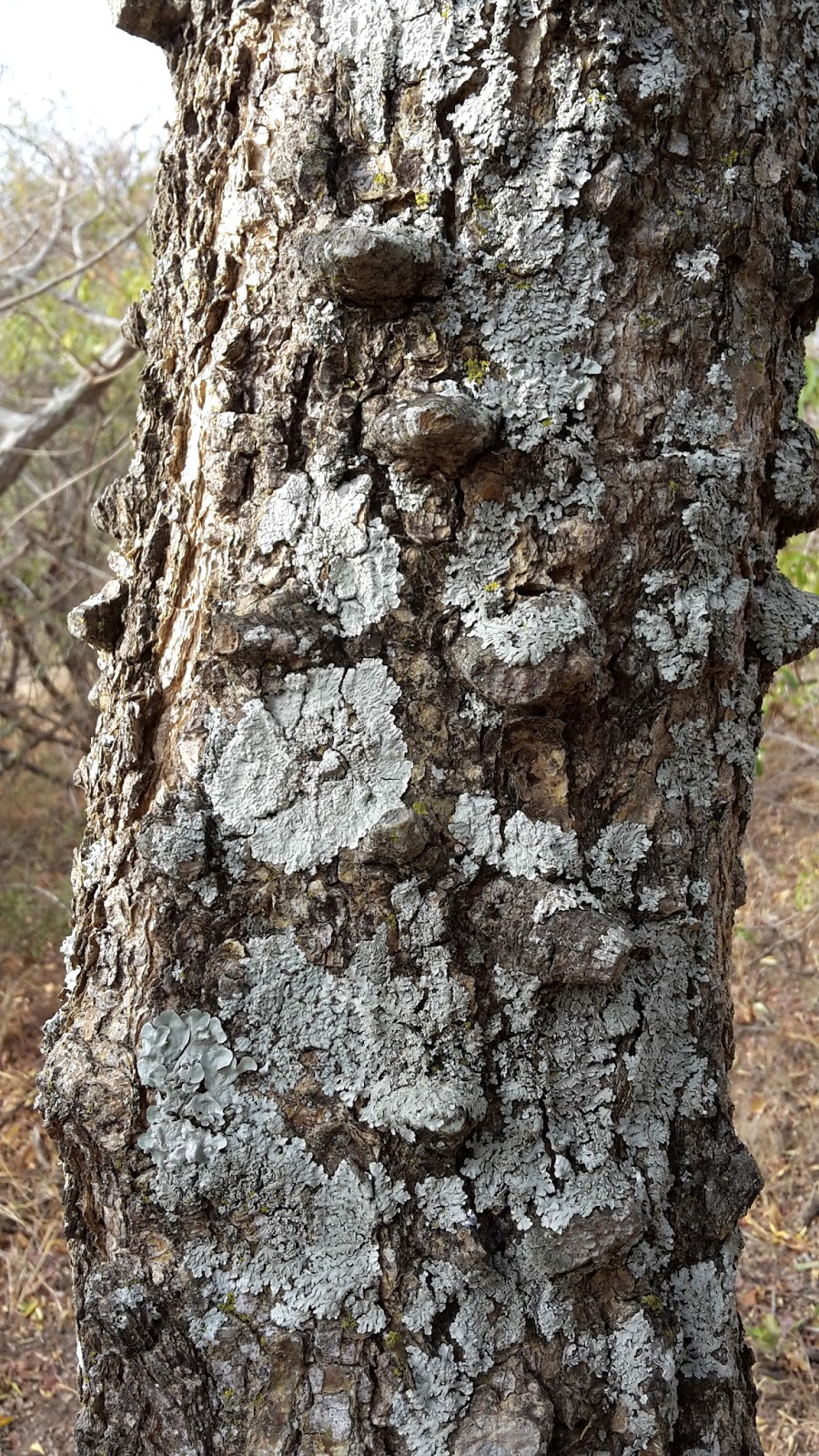
10 fascinating facts about Lichen (trust us, it more interesting than you may think!)

  1.          Lichen is made up of an algae and a fungus living in perfect harmony.  Each needs each other to survive and forms a symbiotic relationship known as ‘obligatory mutualism’.  Such is depth of this relationship that neither party can survive without the other.
  2.         The algae is an autotroph and can thus supply the organism with food produced by photosynthesis, whilst the fungus envelops the algae in order to protect it from desiccation and also provides it with a means to attach to the substrate.
  3.          If the algal and fungal elements of lichen are grown separately, their structures are completely different from that of their combined lichen form.  It seems that when placed together, the fungus envelops the algae to protect it from desiccation, among other things, and creates a completely new, symbiotic structure
  4.          Such is the success of this union, lichen species are abundant and inhabit habitats ranging from sea level to alpine regions, from the Arctic tundra to dry deserts.  In fact, lichen covers 6% of the entire surface of the planet and is considered to be amongst the oldest living things on Earth.
  5.          Lichen is considered an agent of mechanical and chemical weathering.  Whilst the process is exceptionally slow, it is still effective and is an important factor in producing soil over long periods of time.  Man-made structures can also be affected and the Mount Rushmore National Memorial in the USA has to be routinely cleaned by a group of mountain climbers to avoid irreparable damage being done!
  6.          Lichen grows very slowly but regularly depending on the species.  It grows at about 1mm a year and has been used as a technique to age exposed rocks, although it is only accurate up to about 1000 years of age.  It is particularly helpful in aging rocks of less than 500 years are carbon dating techniques are ineffectual at such young ages.
  7.          Lichens do not have a root system and thus get all of the nutrients they need from the atmosphere.  This means that they also absorb a variety of pollutants and many environmental studies with lichen emphasize their role as a feasible biomonitor of air quality
  8.          The pH indicators in the litmus test (to measure acidity and alkalinity) is extracted from the lichen Roccella tinctoria by boiling it
  9.          A selection of Lichen were exposed to the vacuum of space and the full force of the Sun’s radiation for a period of 15 days as passengers on a European Space Agency mission in 2009.  Amazingly, some species continued to grow as normal upon their return, fuelling interest from cosmetic companies looking to develop new sunscreens for human use.
  10.          With the search for new worlds to accommodate Mankind’s relentless population growth, some lichens were exposed to Martian atmospheric conditions in the lab for a period of over 3 weeks in 2012.  Amazingly, despite the weak atmospheric pressure, lack of protection from cosmic radiation, bitter cold and alien atmospheric composition, some species not only survived, but continued to grow and function with relative normality!  Evidence like this has given the scientific community renewed hope of find life on other planets!


Facts and photos by Ben Coley

March 2, 2015

10 Interesting Facts about the Leopard Tortoise

  • The Leopard Tortoise is a member of the small 5 (along with the Rhino Beetle, the red-Billed Buffalo Weaver, Elephant Shrew and the Ant Lion)
  • The Leopard Tortoise eats plant matter, but also old hyaena scat (coprophagia).  They also gnaw on bones (osteophagia).  The high calcium content in both provide essential minerals to keep the tortoise’s shell in good condition and to aid egg shell production
  • Captive Leopard Tortoises can live for 75 years
  • The base of the shell is called the ‘plastron’ and its shape differs between the sexes.  A female has a flat plastron whilst a male has a concave one.  The is designed so that the male can mount the female during mating, his concave plastron fitting around the shell of the female
  • The individual panels of the shell are called ‘scutes’.  These scutes grow in conjunction with growing seasons and thus one can gauge the age of Leopard Tortoise by counting the ridges, just like the rings on a tree.  Due to wear and tear however, the interior ridges are often worn away and thus estimating a specific age is impossible 

  • Leopard Tortoises are the only tortoise not to have a nuchal shield (the protective scute above the neck).  This means the Leopard Tortoise is the only member of the family that can raise its head, and thus is the only member that can swim
  • The sex of a tortoise hatchling is determined by the temperature at which the egg is incubated. (Temperature Dependent Sex Determination).  Eggs incubated between a temperature range of 26-31° will be male and 31-34° will be female
  • The Leopard Tortoise stores water during the dry winter months in a ‘Bursa Sac’.  This reserve is used for hydration and also to moisten the baked ground to make it easier for the female to dig a nest for her eggs 
  • One must never pick up a Leopard Tortoise (or any tortoise) during the winter months as it may eject its stored urine and water as a deterrent.  Due to the distance it must cover to replenish this lost moisture, it may cause the tortoise to die of dehydration
  • The scientific name of the Leopard Tortoise is Geochelone pardalis.  The species ‘pardalis’ comes from the Latin word ‘pardus’ which means ‘spotted’, referring to the patterning of the carapace (shell). The scientific name of the leopard (Panthera pardis) and the giraffe (Giraffa camelopardalus) also reflect their spotted colouration  

Facts written by Ben Coley
Photos taken by Tigris