Showing posts with label knowledge. Show all posts

November 20, 2014

Putting the students to the test!

The current crop of students recently completed their first practical observation test.  70 questions, most centering on identifying phenomena encountered in the bush, would prove a stern examination as to whether the previous 3 week’s information had sunk in.  The morning of the test was like any other but there was an air of unease within the camp.  Students were dotted around the camp, coffee in one hand, book in the other as they used these last vital moments to try to cement their new-found knowledge.  Wide eyes and furrowed brows seemed to be the order of the day.


For the next 6 hours, the students dredged their memory banks as Gerhard and I set them a number of questions related to what we found in the bush.  From tracks to trees, dung to bird calls, the students were subjected to all manner of questions.  Some rounds were tough, some were easier but all our budding guides performed admirably, and many surprised us with the level of detail that they had retained.  The practical observation test is a great way for the students to see how much they have learned but it is also when we find out whether our teaching has been successful!  The pressure is on for us all!  But I am very happy to report that everyone breached the 75% pass mark with many scores being in the 90’s!

This is the first of many practical tests that the students will experience during their quest for an EcoTraining qualification.  In the coming weeks they will have to tackle bird call and slide identification, snake slide ID, frog calls and a second, more challenging practical observation, not to mention a handful of written theory exams.  All of these skills will hopefully set them up well for their final test, the practical assessment, which awaits them in just 3 weeks’ time!

After 8 years guiding in the lodge industry, I have seen all manner of guides ply their trade in the bush.  Some have been good and some, not so.  For the guests that come on safari this may be their one and only chance to experience the majesty of this land, and it is a guide’s obligation to ensure that they have a life-altering journey.  EcoTraining is in the unique position to send out the next generation of field guides with the knowledge that we believe is essential to give a guest the best possible experience.  Make no mistake:  this course is tough, but the rewards one can reap from understanding the complexities and intricacies of the bush are priceless


Blog and photos by Ben Coley

June 4, 2014

Llew Taylor and Riverine Ecology course at Karongwe


Ben Coley, Head Instructor for EcoTraining gave us a bit of insight on the Riverine Ecology Course that took place at Karongwe Game Reserve
Last week, Eco-Training’s Karongwe students were fortunate enough to entertain the services of Llew Llew Taylor from Taylor Environmental.   Llew has spent decades working from various governments environment departments before branching out on his own.  His specialty is something that we know is vital for all life on Earth, but something that we all take for granted: water.
For a day and half, Llew imparted his knowledge, explaining the various properties of water and WHY it, and the ecosystem associated around it is so important.  After a brief lecture, we headed out into the field to examine the quality of the water in the Karongwe River.  One of the best ways to measure the quality of a river is to examine which species of ‘macro-invertebrates’ are found within in.  In order to do this, teams were given the task of taking samples of the water from various different areas, and then identifying its inhabitants.  All organisms have an ecological niche within which they can survive.  Factors such a PH levels and the amount of sediment will dictate which animals can exist within it.  Therefore, each species is assigned a number between 1-15 depending on its rarity.  The rarer the species, the better the water quality. 

The students also did a vegetation survey whereby species of plant life within the riverine boundaries were examined and assigned values based upon their densities.  Most importantly, alien or invasive, species were also identified.  These 2 pools of results were entered into a standardized spreadsheet and the end result showed that the Karongwe River was good quality!

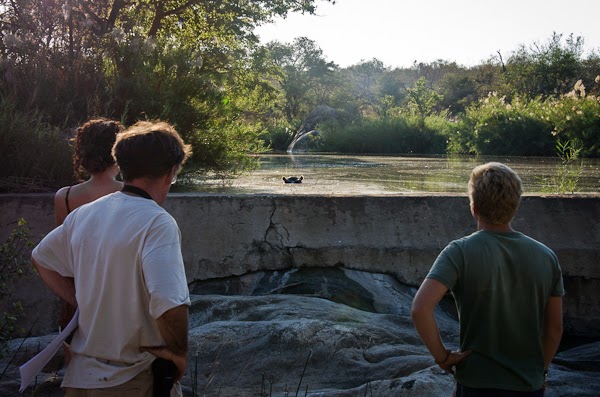
Practical exercises are all enjoyable and the whole process helped to give the students a better understanding of why it is important to respect and understand the riverine ecosystem.  `The position chosen was close to a weir and its high vantage point allowed a resident hippo cow and her young offspring the perfect view of our activities.  At no point did she show any aggression towards us and her demeanour was more one of curiosity as the students busied themselves with nets and petrie dishes! We also took the opportunity to examine some the other riverine inhabitants such as the beautiful scarlet dropwing.
Llew’s experience and knowledge was hugely beneficial in aiding a better understanding of nature’s most valuable elixir and the students were awarded a certificate of achievement at the end of the course.