Showing posts with label Water. Show all posts

October 23, 2015

False sense of security


Elephants have long since been my favourite animal to view in the bush but the past three months have been a great test of my admiration towards them.  Living in the bush is an honour but wherever people and animals coexist, there will always be conflict.  Thanks to a very dry winter, water has become the most valuable commodity on Karongwe.  It is an essential requirement for almost every organism on this planet, and when under water stress, their will to survive is strong.  When the animal in question weighs over 6 tonnes, the outcome is inevitable…

For month after month, the local herd of elephants’ massive water requirements have reeked havoc on our bush oasis.  Elephants are fussy when it comes to water, and when faced with a stagnant pool of water versus the clean water in our tanks, there will only ever going to be one winner.  I soon learned that trying to stop or outsmart them was futile and it pains me to say but I had given up trying.  It had become routine to stockpile water in the evenings and then fix the pipes the next day.  We all had no choice but to accept it.

Finally last week however, the rains came.  Thunder and lightning ravaged the skies and the first downpour of the season was relished by all.  With water no longer in such short supply, the elephants relinquished their relentless raids on our tanks and seemed more content now that natural order had been restored.  We were lucky enough to bump into them the day after and they seemed filled with the joys of spring as they frolicked in one of the dams close by.  Despite my love for these gentle giants being tested to the full over the last few months, nothing could contain my grin as we had a perfect view of the herd splashing about, one even deciding that the occasion was worth a swim!  I am supposed to teach guides to interpret behaviour, but sometimes it needs no interpretation.  Joy is a powerful emotion and it positively oozed from these most emotive of animals.


The elephants moved north, back to the area they tend to spend the summer, and we let our guard down.  For days we enjoyed running water.  Showers seemed sweeter than ever and the simple pleasure of water on demand become common-place once more.  We may have lost the battle but we had won the war.  Battered and bruised yes, but we had weathered the elephantine storm!  The bush however is not without its sense of irony, and whilst I secretly celebrated the end of a long and arduous campaign against an unstoppable enemy, I was in for a rude awakening.  

I slept well that night under the soothing shroud of a false sense of security.  As the morning light filtered through my tent I went to help myself to a refreshing cup of water but when I turned the tap, I was met by nothing but the sound of rushing air (although I swear there was a subtle hint of elephant mockery mixed in with it!).  They had returned.  Like silent assassins in the night they had travelled the length of the reserve and reminded me who indeed was the biggest fish in this newly stocked pond.   Normal service had been resumed I was left with no question as to who had the upper hand in this long-running war!

Hopefully the summer has begun and the pressure on the animals will recede as more rains fall.  Either way, despite their destructive tendencies, they still remain my favourite animals.  Coexistence with nature is whole point and it is up to us to adapt and learn to live together in harmony.   One thing is for sure, whether they are causing mayhem at camp or delighting us with their aquatic antics at a more natural venue, the honour of living in the midst of giants is a true privilege.  

Blog post and photos by Ben Coley

October 9, 2015

Survival 101: What to do when you get lost in the bush

What do you do when things go wrong and you get lost while out in the bush? In a nutshell: Stop, stay calm and plan. Keep warm. Drink plenty of water and ration your food. Conserve your energy. 
Be determined to survive. Get help.

Actually there are a number of things, so let’s tackle this systematically.

The first and most important thing to do is to remain calm and THINK. Then make tea, tea and not coffee. Making tea requires a certain ceremony and if you can take your time and make tea, then you are in charge of the situation. Then take stock of your situation.  

The first option is to turn around and track yourself out of there. Your shoes have left marks on the trail; the tires of the vehicle have left two long lines behind the vehicle. The vehicle will not leave tracks on a tar road but if you are on a tar road then you are probably not lost.

If this still does not work then settle down and make a camp. Take out you little survival pack. What, don’t you have one? You should have packed it before the rest of your kit. Inside should be the following: a small bag or pouch with a lighter, some strong string, a knife and/or a machete; a small pot for cooking and boiling water; soap and a lightweight towel; water sterilizing tablets and coffee filters, to filter water not coffee; insect repellent; a proper first aid kit, not just a packet with first aid written on it.

The weather conditions will determine what type of protection you will need. Do a good job of keeping yourself warm and dry. Find and purify water or ration the water you have. Find fire-wood before it gets dark but use it sparingly. Have a pile of small sticks that you can throw on if there is a threat from animals. Feed the fire slowly, do not heap it up and then let it die down to almost nothing.

Stay near the vehicle if you are using one. The vehicle is easier to see than people on foot. You should have left a rout plan and return date with someone. Stick to the plan. Do not ever deviate from your plan. If you do not return by the set day then they will send people out to find you. You should know your equipment; know how to use it when it works properly as well as when it is not functioning properly. The boy scouts motto of “be prepared” says it all.

Look around you as you travel, look back at any junctions that you pass, see them from the return journey’s perspective. Learn to use your equipment properly and then practice regularly. Learn some skills and practice them regularly; learned skills are lighter to carry than a book. And very importantly – NEVER over-estimate your capabilities but be positive about what you can do.


Courtesy of EcoTraining instructor Mark Gunn - article written by Liryn de Jager

June 4, 2014

Llew Taylor and Riverine Ecology course at Karongwe


Ben Coley, Head Instructor for EcoTraining gave us a bit of insight on the Riverine Ecology Course that took place at Karongwe Game Reserve
Last week, Eco-Training’s Karongwe students were fortunate enough to entertain the services of Llew Llew Taylor from Taylor Environmental.   Llew has spent decades working from various governments environment departments before branching out on his own.  His specialty is something that we know is vital for all life on Earth, but something that we all take for granted: water.
For a day and half, Llew imparted his knowledge, explaining the various properties of water and WHY it, and the ecosystem associated around it is so important.  After a brief lecture, we headed out into the field to examine the quality of the water in the Karongwe River.  One of the best ways to measure the quality of a river is to examine which species of ‘macro-invertebrates’ are found within in.  In order to do this, teams were given the task of taking samples of the water from various different areas, and then identifying its inhabitants.  All organisms have an ecological niche within which they can survive.  Factors such a PH levels and the amount of sediment will dictate which animals can exist within it.  Therefore, each species is assigned a number between 1-15 depending on its rarity.  The rarer the species, the better the water quality. 

The students also did a vegetation survey whereby species of plant life within the riverine boundaries were examined and assigned values based upon their densities.  Most importantly, alien or invasive, species were also identified.  These 2 pools of results were entered into a standardized spreadsheet and the end result showed that the Karongwe River was good quality!

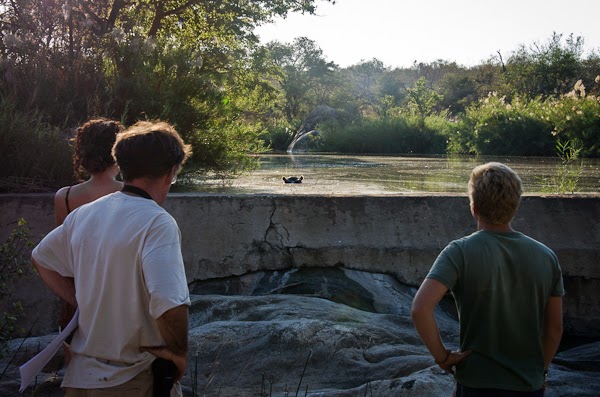
Practical exercises are all enjoyable and the whole process helped to give the students a better understanding of why it is important to respect and understand the riverine ecosystem.  `The position chosen was close to a weir and its high vantage point allowed a resident hippo cow and her young offspring the perfect view of our activities.  At no point did she show any aggression towards us and her demeanour was more one of curiosity as the students busied themselves with nets and petrie dishes! We also took the opportunity to examine some the other riverine inhabitants such as the beautiful scarlet dropwing.
Llew’s experience and knowledge was hugely beneficial in aiding a better understanding of nature’s most valuable elixir and the students were awarded a certificate of achievement at the end of the course.     


October 13, 2011

Crystal River - Colombia


Cano Cristales - Crystal River. River of five colors, as the locals call it, originates in the south of the mountain chain Macarena, Colombia, and flows eastward to its confluence with the Guayabero river. In the Cano Cristales found five colors: yellow, blue, green, black and red. All of them are waste product of many algae and, depending on time of year, color saturation, or weakened or strengthened.