Showing posts with label adventure. Show all posts

January 22, 2016

MAKULEKE AS I SEE IT...

In this blog Vaughn will take you on a journey to the bush and make you want to leave everything behind to get that same down to earth experience he is describing. This is what he had to say:

"Tucked away in the far North of Kruger National Park, hugged by two rivers and littered with baobabs, lies a truly remarkable piece of land. 26000ha of pristine wilderness, as rich in ecological biodiversity as it is is in cultural history.

I first set foot in the Makuleke concession, also known as the Pafuri triangle, one unusually balmy day in July a few years ago. I had just embarked on a life changing adventure, a transition from overworked and underpaid diesel mechanic on South Africa's platinum mines to intrepid trails guide and all round quality South African safari guide. Well, at least that is what I thought at the time anyway. I had no idea of the roller coaster ride of self discovery, laughter, tears, love and friendship that lay ahead of me.

Looking back on an unbelievable couple of years, there is without a doubt, one element that stands out. The starting point and solid bedrock of my personal journey. A constant in a continually changing and evolving set of memories, decisions and chances. Makuleke.

Sure, I understand, how can I possibly expect you to believe that a piece of land can have such a profound affect on a person's life. I mean, when you break it down and strip it bare, it is merely a bunch of biotic and abiotic components reacting and inter-reacting, creating relationships and inter relationships and forming a canvas on which a picture of life can be painted... But Makuleke is not just another piece of land. It is an expertly woven tapestry with a beauty and complexity very rarely seen. It is a small piece of wild heaven, a big step back into Old Africa. It is a place where magic not only exists, but where you can see it every single day. Join me on a walk through the heart of one of South Africa's last true remaining wilderness areas as Alan mcSmith an I, try to shine a gentle light of understanding on some of the secrets of the ebb and flow of life and history in the unique and truely memorizing Makuleke concession." - Vaughn Du Plooy

May 21, 2015

Navigational Walk with EcoTraining Students in the Croc Dam area of Karongwe Game Reserve

The sun was well up and making its presence felt as we departed Ladder Kopje with Shelly Tomkins now leading the Group, her destination being Croc Dam away to our North East. The vegetation was thick at first with progress being slow but once Shelly had picked up the clear game paths following the drainage line to our left, the going became much easier.

With the game paths now starting to converge on a regular basis, Shelly crossed the drainage line and led us into the lower reaches of Croc Dam, the raucous grunts of the resident Hippos and the often hysterical cries of the Egyptian Geese giving her the comfort that she had indeed successfully found her way to the correct spot! A convenient exposed granite outcrop reaching out into the water provided an ideal rest-up spot for the Group while also providing a great view of the dam to our left and right.

With the Hippos just below the dam wall to our right, a clutch of Egyptian Geese goslings being shepherded by their parents into the water to our front, some very large crocodiles drifting effortlessly in our direction, an African Darter spreading its drenched wings to dry and an African Fish Eagle regally surveying its territory from its lofty perch to our north, all providing for an amazing early morning setting for the Group, well worth the many kilometres already under the belt on this morning’s navigational walk.

Croc Dam, Karongwe, Navigational Walk. The African Darter and large Crocodile can be seen while the Egyptian Geese family is just visible in the top right. Photo: Tim Flavell

The African Fish Eagle surveys its territory. Photo: Tim Flavell
All too soon it was time for the map to be handed to Jake Cook for the next leg. He briefed the Group on our destination and began re-tracing our steps for a short distance along the bank before heading off to the South East to his distant destination. As Jake led us into a shady thicket just off the bank with the water to our right, an unmistakable warning growl stopped us in our tracks! “Lions..!!” mouthed Jake pointing beyond the thicket into the open area ahead of us. Lions indeed, the immature male, his fledgling mane just visible, was lying in the open staring intently in our direction!

The immature Male eyes our thicket! Photo: Tim Flavell
I quickly motioned Jake behind me and brought the Group together, thankful for the cover the thicket was able to provide. Crouching down we could clearly see the big male on the edge of the tree-line just behind the juvenile, his face encircled by his massive mane !

Our view of the big male! A great sighting for the students! Photo: Tim Flavell
I heard a digital whirr behind me, Tim hadn’t forgotten his camera and was clicking away merrily. The Lions in view were seemingly comfortable so we crouched down and watched these magnificent animals. Aware that this was only a small portion of the Pride, I shifted the Group slowly to the right bringing two lionesses into view to the left of the youngster, both of them moving to our left. With the water to our right, escape routes were limited while there were another three lions still unaccounted for. It was definitely time to leave and not overstay our welcome! Particularly with the lionesses on the move!

I motioned to Jake to lead the Group out of the thicket, back the way we had come with me bringing up the rear keeping myself between the Group and the Lions. As soon as we were clear I took the lead and moved at least five hundred metres away from the Lions’ last position, past the granite outcrop on which we had enjoyed our break. Once stopped, the Group broke into animated whispers and shared experiences of a wonderful encounter. However, as I looked up from our new position back from whence we come, the big male’s large head appeared from the scrub line not 60 metres away!!

The Pride was obviously making their way North and we were in their way!

I quickly but quietly asked everybody to stand behind me, Tim’s camera again working overtime! The big male then lay down in the shade but with the two lionesses flanking him, once more on the move!
The big male as we saw him for the second time! Photo: Tim Flavell
Again it was no time to hang around, warning the Group I would be walking hard, I headed north towards and beyond the dam wall following the incoming game paths well clear of the area. I then looped back to the east in a wide arc in the general direction of where the vehicle was parked.

With more than enough distance now between us and the Pride, I asked Jake to re-orientate himself and lead us back to the vehicle! An amazing morning in a really beautiful area highlighted by a great encounter with the Lions.


Rhodes Bezuidenhout
Instructor
EcoTraining, Navigation & Orientation Course
Karongwe

November 6, 2014

A dramatic, yet spectacular conclusion to an exciting game drive

The Lion:  the epitome of any safari and usually the top of the list for anyone venturing into deepest darkest Africa.  The students at Karongwe are here to learn how to guide; to understand the inter-connectivity of everything on this wondrous planet, from the bedrock that shapes our world, to the birds soaring thousands of feet above our head, but where possible, a big game sighting is always welcomed!

The radio crackled to life.  Lions.  Kill.  Feeding.  The words that everyone wants to hear.  Anticipation reached fever pitch as we turned on the ‘two track’ as the light began to fade and we started to twist our way into the depths of the bush.  The private world of a lion pride was soon revealed to the future generation of guides as we rounded a bend and came face to face with 4 sub adults busily dismantling what was left of a blue wildebeest.  Two rather obese looking lionesses lay close by, panting heavily to get the necessary oxygen to aid in digesting the gargantuan amount of meat that was sitting heavily in the swollen bellies.  No one spoke as we listened to the razor sharp carnassial teeth of the young lions slice through flesh, muscle and sinew; the scene illuminated by the spotlight like actors on a stage.

Lion cubs feasting on the kill

To some, the scene seemed gruesome, to others it was a sight that they had hoped for since their course was booked.  Whatever the interpretation, nothing changes the fact that out in the wild, this is life.  Its kill or be killed.  The wildebeest’s demise was unfortunate, but its sacrifice will ensure that the lion pride of Karongwe will not go hungry, and that the next generation will be able to develop into mature adults.  What we were witnessing was a perfect example of the recycling and sharing of nutrients in the wild.  Out here, nothing is wasted.  Energy cannot be created or destroyed, only its path altered.  This is one of the cruxes of ecology and the students were given a first-hand insight into the perfect design of the natural world.


Cameras flashed and students barked questions regarding the diet, pride dynamics and habits of one of the world’s most iconic predators.  I did my best to field the questions but felt like a cricketer in the firing line of 9 of the world’s best fast bowlers!  As darkness descended around us, the other vehicles came and went until we were alone with the scene.  Nature has a dramatic streak however, and seemingly on cue, decided to augment our experience.  The clouds rolled in, tongues of fork lighting lit up the air and ominous thunder reverberated in the distance.  Nature’s drama was complete.


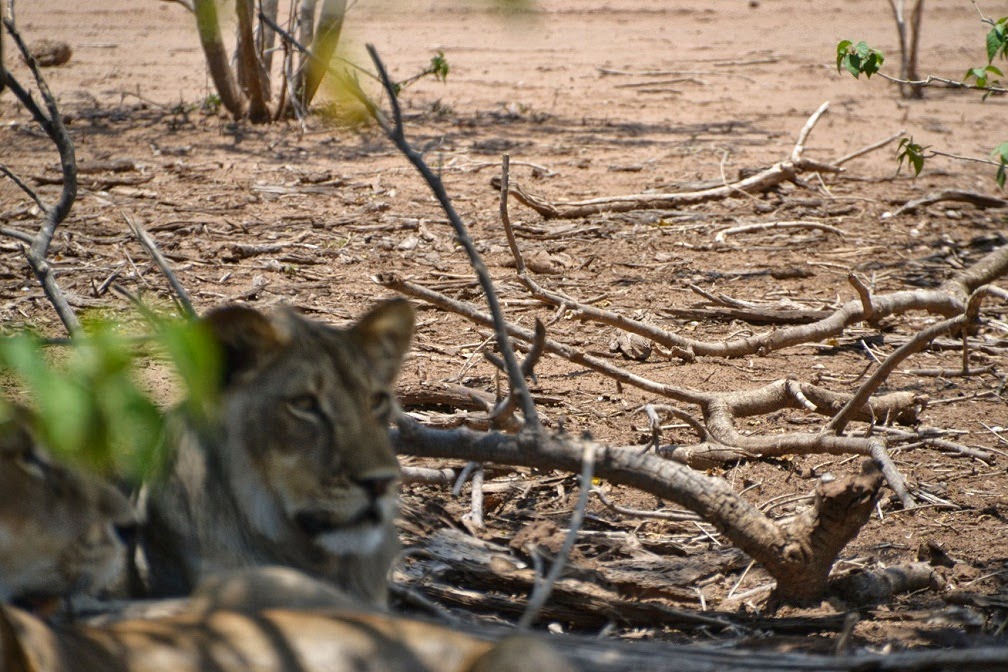
Lionness 
We left the pride to their meal, heading home at a reasonable pace to seek shelter before the heavens above us opened in the first proper thunder storm of the season.  The drive back was an adventure itself with the surrounding area being regularly lit by bolts of brilliant light dancing across the sky.  As every strike snaked its way through the heavens, the land rover was filled with ooohs and aaahs, just like a crowd at a firework display.  The sighting had been a good one, but the drive back was epic, putting the meagre power of a pride of lions into perspective as Mother Nature flexed her infinite muscles.  What a spectacular way to end a life altering experience for many of the EcoTraining guides-in-training!

Blogpost and photos by Ben Coley


August 22, 2014

Elephant Armageddon


 A Blog post by Ben Coley

"I fell asleep at a reasonable hour listening to the rhythmical songs of the fiery-necked nightjars and the distant booming call of a Verreaux’s Eagle Owl.  Somewhere far in the distance I heard a branch break as it succumbed to the devastating force of its elephantine assailant; but other than that, the bush’s gentle nocturnal lullaby was more than enough to send me into a deep sleep.

I woke with a start at about 11.30pm.  The moonlit night sky was no longer visible through my tent’s mesh:  cloud-cover I mused?  Perhaps it was a clap of thunder that had disturbed my slumber?  As I strained my sleep filled eyes, the moonlight suddenly started to appear once again… It was only then that I realised that it was the silhouette of an elephant bull that filled my window!  He then set about systematically removing large areas of bush from beside my tent with less than delicate aplomb.  The silent night provided perfect amplification for his activities and the cracks of the protesting branches sounded like gunshots going off next to my head!  More noise filtered through to my now more alert brain and I realised that our friendly behemoths from 2 days ago has decided to pay us another visit! 

My first thought was the water pipe outside my room.  It had recently been fixed and had yet to be buried beneath the soil.  Elephants have a penchant for fresh water and I knew that it was only a matter of time before he would snap the pipe like a matchstick to quench his considerable thirst.  Sure enough, minutes later I heard a pop and the gushing of water, followed by what can only be described as someone guzzling a drink through a massive straw!  Water is Africa’s most precious resource.  It is the life blood that supports the wealth of plant and animal life that we as bush-folk hold so dear and I knew that I had to stem the flow when the opportunity arose.  I clambered out of bed, armed only with my headtorch and watched the carnage through the mesh until the satiated colossus silently strode up my path and away from his destruction.  Thankfully, the mains tap was close to my tent so I was able to tip-toe my way 30m or so through the darkness and conserve our vital elixir.

The chaos continued throughout the night and sleep was hard to come by.  Normally elephants feed in an area and move on but perhaps EcoTraining’s famed hospitality was too enticing and our guests were still in the camp at 5.30am when I, and the somewhat shaken-up and bleary-eyed students emerged from our tents.  Ironically, only a few nights ago I was telling them that camp visitors are common, despite the fact that that they had been scarce of late!

We surveyed the devastation together, keeping a watchful eye on the 2 perpetrators as they continued to feed close-by, oblivious to the disturbance that they had caused.  One tree blocked our path to the fire place, another had narrowly missed the EcoTraining sign and yet another tree had been uprooted right next to tent 7.  Beatriz and Rosie were the unfortunate inhabitants as they told of their sleepless night!  The pathways were littered with foliage and branches where the table manners of our gargantuan visitors seemed to have deserted them.  We stepped carefully through the carnage, avoiding regular calling cards the size of bowling balls as we all recounted our own experiences of the chaotic night.  Finally the bulls moved on, satisfied that they had left their mark on Karongwe camp.  I couldn’t help but spare a thought for the remaining vegetation, wondering of their thoughts for their fallen comrades.

Considering their destructive capabilities, no structural damage had been sustained, and more importantly, with the exception of sleep deprivation, none of the camp guests had been harmed.  The elephants knew we were here; they would have been able to smell us and hear us shifting uncomfortably in our beds as they cut a swathe through our little oasis, but yet they continued about their nocturnal activities regardless.  It was an ultimate example of how man and beast can live together in harmony, and yet another memorable African experience for the Safari Guide course of August 2014!"


August 4, 2014

Professional Field Guide Course - Book Now


One of EcoTraining’s most popular courses is the Professional field guide course. For one year you will be exposed to diverse ecological and geological terrains, landscapes, wildlife species and so much more at our wilderness camps in places like Makuleke, Karongwe, Selati (South Africa) and Mashatu (Botswana). A constantly stimulating environment to learn is aided by our instructors, all having many years of guide training experience and time in the bush, and each with their own unique way of training and guiding that will enhance your overall training experience.

Visit our webpage for more information - http://www.ecotraining.co.za/courses/fgasa-accredited-courses/13-professional-field-guide


June 17, 2014

EcoTraining Selati - Sable Breeding Camp Trip

The students at Selati were given the opportunity to visit the sable breeding farm in the far north of the reserve.  The diversity of the course offered by EcoTraining is such that students are exposed to not only fascinating facts about the bush, but also how conservation management fits into the equation.  Sable are one of the rarest antelope to be found in southern Africa and their value is such that entire reserves are able to exist through their sales and breeding.  Selati is one of those areas and the 33,000 hectares are fully funded, not by commercial lodges, but exclusively through the funds generated by Sable breeding project.

We were met by the farm manager Hannes, a former guide who started with almost no knowledge about breeding Sable, but after 7 years of hard work is now one of the pioneers into Sable breeding and is the man responsible for generating the funds that allow Selati to prosper.  Hannes’ enthusiasm and love of sable is evident and he gave the students a detailed lesson in how they are bred and generate the income through the programme, as well as insightful information about the behaviour of this stunning animal.  The students were fascinated by the process and Hannes was subjected to a barrage of questions about the various processes!
After a couple of hours, we stopped for a packed breakfast in the bush before heading back to camp.  On the way, we stopped off at the largest baobab tree on the Selati reserve and received a quick lesson on this magnificent tree.  Although not as big as some specimens, for many it was their first time to see the fabled behemoth and all delighted in the experience.  The road back to camp was peppered with elephant damage and much energy was expended as the students discovered the delights of working in an area that comes complete with its own set of landscape gardeners!  Quite why the elephants seem to revel in felling trees across roads was beyond us, but we all enjoyed a bit of physical labour after to get the blood pumping!


February 7, 2014

THROUGH THE BUSH TELEGRAPH: Look before you leap – Selati


If there’s one guarantee in nature, it is that the unexpected is sure to happen, as sure as the sun rises in the east and sets in the west. As this update from Christine Jutz from our wilderness camp in the Selati Game Reserve clearly indicates:

“Instructor Mark Gunn would always tell us that part of guiding and conservation is to clear the road of any overhanging branches, as this would prevent the creation of new roads and so disturbing the natural environment. So every once in a while, he would stop the vehicle and say “Tracker, take the panga and help me to get this branch.”

Then of course the following happened on one of the drives… Our ‘tracker’, fellow student JJ, jumped off his seat, grabbed the panga, and as he was walking to the sickle bush, everybody on the vehicle started yelling “Lion, lion!”

Less than five meters from JJ, two lionesses and a young male rose from the vegetation where they were sleeping before we attempted to clear the sickle bush.


JJ levitated back to the vehicle in a single bound, and the lesson was learnt: Look before you leap!”

NOTE: The picture is not of the lions in this story, it is however of the Selati lions. 

October 23, 2013

LIVE THE MAKULEKE MAGIC: ECOQUEST – 26 NOVEMBER-9 DECEMBER


Imagine a place where elephants and buffalo congregate in numbers, impalas and nyalas skirt each other, bushpigs and aardvark put in brief appearances, lions and hyenas make their presence known as well, and Pel’s fishing owls and wattle-eyed flycatchers delight in flight.

Such a magical place does indeed exist. In the far north of the Kruger National Park the Pafuri region stretches over 24 000 hectares between the Limpopo and Luvuvhu rivers. And within lays the Makuleke Concession.


The diversity of the animal and bird life and flora in this area is truly something to behold. It forms but a very small percentage of the park, but holds about 75 % of the biodiversity of this paradise. It is certainly the wildest and most remote part of the park, making for an experience par none when it comes to wildlife viewing and even better birding, all amid varied vegetation.

You too can experience this…


Book a place on the EcoQuest course (14 days) from 26 November-9 December and take a pre-Christmas holiday far from the madding crowds in the EcoTraining wilderness camp in Makuleke.

If you are an adventurous spirit, if you are looking for a more in-depth bush experience, learning about all things wild and wonderful, then EcoQuest is for you. In the process, you will get to experience some of the daily activities of a field guide. And on top of it all, we show you how to drive a 4x4 vehicle, to identify birds, plants, trees and tracks.


Sounds like fun?


Then send an email to enquiries@ecotraining.co.za and end 2013 on a memorable note!

October 17, 2013

28 DAY SAFARI GUIDE COURSE: PUT THIS ONE IN YOUR CHRISTMAS STOCKING – MASHATU, KARONGWE, SELATI


So many things to do, so little time… Therefore the EcoTraining 28 Day Safari Guide course from 26 November-23 December is just the right way to make 2013 a year to remember.

From three of our wilderness camps – Mashatu (Botswana), Karongwe, Selati (South Africa) – you will experience an unrivalled bush holiday whilst learning about the environment in a unique and exciting way. It is for those that are passionate about nature, who would like a more in-depth experience and understanding of it. The knowledge you gain on this course will take your safaris and bush holidays to the next level and give them a whole new meaning.

You will also get to immerse yourself in the unique animal and plant life of three different reserves on this specific course – each with its own sense of allure.

And experiences like this, described by a course participant, won’t be out of the ordinary…


“We were about to sit down for dinner when we heard a lion roaring just outside of camp. We hopped into the Land Rover… It was a lone lioness and she called several more times while walking past the camp, attracting the attention of several spotted hyenas. 

Continuing a feud as old as time, three hyenas came looking for her and found her, while five more circled around behind.  She held her ground until the hyenas attacked, and then she let out a ferocious snarl and swiped at one of them before running for the nearest nyala tree. The hyenas followed in pursuit and stalked around the tree. 

The next morning, tracks showed that two male lions eventually joined the fray, probably dispersing the hyenas, allowing the lioness to come down.”

Here’s a diary snippet from another fortunate participant to whet the appetite…


“Lions were spotted just across camp! We followed the tracks and found five lions after one hour of walking. What a great experience! The cubs were playing around but at the same time also very alert. The female started growling at us, swishing her tail. Eventually they all started growling at us. We had an awesome sighting and had to back out because of the alertness, growls and warning signs. We continued the walk away from them. And then, to top it all, we also saw a bat eared fox! Not to mention the many kudu and impala in the riverbed and the vultures in the sky. It was a lovely walk in the cool breeze.”

And if that wasn’t enough…

“The sun was setting rapidly, and as darkness descended the radio call came in: ‘There are lions in camp! They are close to Tent 13!’ We raced off back to camp after I instructed all the guys in camp to gather in the main lecture area or to stay in their tents. As we approached the camp, we decided to go and see exactly where the lions were, and how many there were so that we could make a judgement call as to what the next plan of action would be.


As we came around the corner, there they were; 3 of them, sprawled out in the middle of the pathway leading from the instructor’s tent to tent 13. It was a lioness and her sub-adult nephew and niece. They were quite relaxed before the young male got up and walked to tent 12. As he disappeared out of view we kept on looking at the older lioness who was very relaxed with in our company.”

So come on, what are you waiting for? Get in touch and book your place – 26 November-23 December – Mashatu, Karongwe, Selati – Email enquiries@ecotraining.co.za.


(Thank you Agnes van der Heijde for the photos!)

September 1, 2013

FOR THE ADVENTUROUS SPIRIT – WILDERNESS SKILLS TRAILS COURSE – 17-22 SEPTEMBER – MAKULEKE

What if, even just for a few days, you can experience something totally unique, inspiring and maybe even life changing?

Just imagine this – the dawn chorus of francolins waking you up, then sipping on a warm cuppa to get the morning going, waiting for a zebra crossing of a different kind, observing big grey beasts from a safe distance, straining the ears for yet unidentified sounds, unearthing fascinating facts about all things wild and wonderful and ringing in the night around a crackling camp fire?

If you have a love of nature, a wilderness spirit and seeking adventure, then this is your last chance to book your place on the upcoming EcoTraining Wilderness Skills Trails course from 17-22 September 2013. Send an email to enquiries@ecotraining.co.za to make sure you become part of the bigger wilder picture, rejuvenate the spirit and help the greater cause of conservation!

The 5 nights/6 days course will be spend exploring the 24 000 hectare Makuleke concession inside the Kruger National Park on foot. It has almost no roads, has the largest fever tree forest in South Africa, two perennial rivers, 12 natural springs, has open borders with two countries and lies in the middle of the Limpopo Transfrontier National Park. 


Lessons you will be taught will not be found in any books, but will rather be hands on learning. Candidates will be encouraged to participate in navigation, planning and setting up eco-friendly camp sites, night watch and trailing and tracking animals where appropriate.

You will have an unbelievable time while gaining a better understanding for all things wild and wonderful, while at the same time making your contribution to the conservation of the natural world.


And if you are still contemplating, these eloquent words of a participant on a previous Wilderness Skills Trails course, will surely make you make THAT BOOKING:

“We all used to live in a cave
And hear the sound that nature gave
That sound that carries like a wave
That sound that we must now save
It was an ancient memory
That told me not to run or flee
When I heard the lion roar
I just wanted more, more, more
The sound is in the soul, the blood
It makes the heart go thud, thud, thud
The sound that makes your throat go gulp
And turns your insides into pulp
A visceral feeling
Inspired kneeling
Spiritual healing”


For more information, visit www.ecotraining.co.za or send an email to enquiries@ecotraining.co.za

August 27, 2013

ECOTRAINING: PASSIONATE ABOUT CONSERVATION

From humble beginnings way back in 1993, when a handful of passionate individuals saw the opportunity to provide the tourism industry with qualified nature-guides, to the leader in this field today.

This is the story of EcoTraining.

For the past 20 years, thousands of people with a deep love for nature, an appreciation of all things wild and wonderful and a passion for conservation, have attended our courses in wilderness camps across Africa.  And armed with this knowledge, they have gone on to make a difference and spread the message of reconnecting with nature in a meaningful way.

Michael Clark, who trained with EcoTraining more than 10 years ago, is currently in Nepal, training up young Nepali naturalists. 

Says Michael:

“The variety of subjects is incredibly diverse and comprehensive, and the practical element provides you with experiences that are hard to put into words. Anyone who is serious about a career in eco-tourism or simply wants a sabbatical from work, the experiences you can have on a course can lead to a whole new way of life, and provide you with memories to truly cherish.”

Like Marc Lindsay Rea, who says he’s now living the dream, thanks in part to EcoTraining who has put him in a very privilege position indeed, as a fully qualified field guide leading people into the wilderness and onto memory-making adventures.


“I have such a thirst for acquiring knowledge about wildlife and nature from around the world and I am lucky to have the privilege to guide guests through these exciting places. I thank and appreciate everybody and every company that has put in many long hours to help get me to the position I am at now. Thank you!”

Yes, we are essentially a field guide training company, training guides for the industry. But with shorter courses and excursions on birding, tracking, photography and bush survival, and from anything between four and 28 days, we are also catering to the tourist with a conscience.

Today’s tourist is a thinking traveler who wants to have fun while gaining a better understanding of the natural world. And this is where a company like EcoTraining is stepping in and creating an experience with a difference.


Like Richard Schmid from Switzerland who was born in Mombasa and spent the first seven years of his life in Kenya. He went back to the country of his birth to take part in a 28 Day Field Guide course in the Lewa Wildlife Conservancy.

For Richard there’s no other way to travel.

“I travel like this all the time, to go out and actually do something, on a course like this to be directly and actively involved in something. I now know so much more, my base of knowledge has broadened considerably and I’m not regretting it for one moment. We have an ecological responsibility and I think people are becoming more and more aware of it all the time.”

Through the years the EcoTraining qualification have become the trusted nature-guide training standard in the industry, giving people from all walks of life and from all over the globe the opportunity to become one with nature. We have trained all across the African continent and also in many other parts of the world.


And our wilderness camps in South Africa (Makuleke, Selati, Karongwe), Botswana (Mashatu) and Kenya (Lewa), is where it is all happening. It’s in these simple unfenced bush camps in the middle of these great wilderness areas participants truly get to experience what it is like to live in wild places. Under the guidance of experienced instructors, countless hours are spend walking or driving in the bush, and an understanding of our place in the natural world is cultivated.

Africa indeed just has its way with people. The continent’s wild and wonderful places lure people from all over the globe, to come and explore and then to return wherever they are from with vivid memories to last a life time.

You will get all this, and so much more, on an EcoTraining course.


But don’t just take our word for it. From the horse’s mouth, or in this case, Nick Baker, a former professional field guide course participant:

“The beauty of this course is the extended time one spends out there, nothing is rushed and every day one learns something new, building a quite awesome knowledge base… I miss it today and will miss it every day that I am not there. The experience is total and is built of a complicated set of components, animals, birds, trees, plants, insects, soil, water, weather, stars, sights, sounds, smells, magic…  The bush does funny things to your head. It has got inside mine…”


Candice Wagener McGuire echoes these sentiments:


“I guide because I like sharing my passion with those around me, I love seeing how the bush inspires every single being. My day is made when I see how people brighten up when they spend their holiday in the bush, how the smallest things put a smile on their faces. When I guide, I feel like I’m making a small difference to keep Africa alive in everyone’s hearts.”

August 21, 2013

PROFESSIONAL FIELD GUIDE COURSE: Testimony that you’ll have the time of your life!


The time is NOW to make that jump into an adventure of epic proportions. EcoTraining’s professional field guide course will change your life and put you on a path sure to be more exciting than you can ever imagine.

The next one is about to start, in September, and for a limited period of time being offered at a special rate. Email enquiries@ecotraining.co.za and make sure that you are among the lucky ones!

Like Marc Lindsay Rea, who says he’s now living the dream, thanks in part to EcoTraining who has put him in a very privilege position indeed.

Here is his story, enjoy, and be prepared to book your place afterwards…

“When I was 11 my father went on a business trip to Phinda Private game reserve and returned home with a brochure of CC Africa. I was amazed by the images… From that day on I knew I wanted to work in the bush and become a ranger. 

So it was a natural choice for me to do a game ranging and lodge management diploma after school, which I passed with an overall distinction. During my diploma course I did two EcoTraining courses, at Selati and Makuleke. This was the first time I had actually spent a solid amount of time in the bush doing training. It was brilliant.

After my course and practical experiences at EcoTraining, I approached AndBeyond and passed their selection phase and relevant training and was offered a job at Madikwe Safari Lodge. Since starting my guiding career in early in 2006, I steadily climbed the ranks becoming a senior ranger, mentor, assistant head ranger and was then appointed as head ranger in October 2008.

For most of 2011 I spent my time working in Namibia at Sossusvlei Desert Lodge. I also spent time working in Botswana at Nxabega and Sandibe lodge in the Okavango delta for AndBeyond.

In 2012 whilst working as a ranger and a specialist guide at Phinda Game Reserve I was nominated by my peers to compete in the Safari Guide of the year 2012. I made it into the top eight rangers in the country and in the finals I won two out of the six categories we were all being assessed on.

I have completed my FGASA Level 3 and have also got my Level 2 trackers qualification. In addition I’ve got a full trails guide walking qualification with hundreds of hours of walking experience and dangerous game encounters on foot. This is one of my favourite ways of experiencing the bush and encourage all my guests to come tracking big game on foot with me.

After the competition Africa Direct noticed me and my skills in the bush and offered me a position to become a private, specialist guide in their company. I now get to travel all over Africa with my guests and am at the pinnacle of my guiding career.

I thank and appreciate everybody and every company that has put in many long hours to help get me to the position I am at now. Thank you!

In addition to the bush I have a massive passion for wildlife photography. I have been placed first and third in two international competitions: Africa Geographic / Canon Field Guides Competition and Wildside Nikon All Africa Competition respectively.

I have travelled to a large number of countries around the globe but nothing compares to the excitement of travelling Africa. I am very serious birder and am called a twitcher by many of my friends. Because of my love for birding I have explored the remotest parts of Mozambique, Zimbabwe, Botswana and Namibia looking for all the special rarities.

In 2009 I founded a small non-profit organisation with the help of my work colleagues and some guests to support the Matetsi Community along the Zambezi River in Zimbabwe. We helped 150 people for 3 years supplying them with vegetable seeds, clothing, toiletries and fishing equipment to try make living a little easier over that difficult time in the country.

I have such a thirst for acquiring knowledge about wildlife and nature from around the world and I am lucky to have the privilege to guide guests through these exciting places.”


(Thanks for sharing Marc!) 

June 11, 2013

TAKE A WALK ON THE WILD SIDE: 10 AUGUST-6 SEPTEMBER 2013 – 28 DAY KENYA SAFARI GUIDE – LEWA WILDLIFE CONSERVANCY


If you think about Africa, you think of wide open spaces, teaming with an array of wildlife and sunsets par none. This magical continent just has its way with people, something that can’t be explained unless experienced, the ‘TIA’-feeling (This Is Africa) it has been described as.

It’s the lure of these wild and wonderful places that draw people time and again to EcoTraining’s 28 Day Kenya Safari Guide Course in the Lewa Wildlife Conservancy. The next one is around the corner…

And EcoTraining instructor Mark Gunn explains just why you have to make THAT booking.


“It is with great admiration that I read the stories of the exploration of Africa by the likes of Livingstone, Baynes, Burton and Speke. What was it like to walk across the plains with these men of men? They chose to leave a sheltered Victorian, gentleman’s life and head off into the “dark continent”. They struggled with adversity, disease and danger from the local population. Some of them died and never came home. 

However, what did they see? Great open spaces and herds of the most incredible animals on earth. Amazing vistas and a fantastic kaleidoscope of cultures were the order of the day, every day. We can do the same today without the same threats and dangers that they faced.

The modern urban world does not have the denizens of the plains to contend with, urban people have transferred their admiration onto sports stars, music divas and the odd dictator. Escape from this artificial world of artificial heroes is surprisingly easy.


A walk with the wildlife on Lewa is so easy to do and after the initiates first two or three encounters with the big and hairies, easy to enjoy.

Appreciate is not the word to do justice to the feelings you get when you are walking so close to elephants that you can hear their feet rustle through the grass and hear them chewing the food that they tirelessly stuff into their great maws, enjoyment, absolute pleasure, is an emotion that surges to the fore whenever I am in the presence of these great, peaceful colossi. Sharing a few minutes in the life of these behemoths of the African savannah is a pleasure that needs to be experienced.

No amount of eloquence, no matter how well the author can extract adjectives from our beloved dictionaries, will ever do justice to the act of being there.


Following a lion across the grassland while avoiding getting too close to rhino and buffalo, skirting around a group of reticulated giraffe and intercepting the lion just before he move between two herds of elephant, this being there.

Returning from an encounter with such majesty is not a simple task, there are herds to be passed and circumvented so as not to disturb them and ensure our safe return to the culinary delights that have been prepared by our camp staff.


Experiences that defy description are not relived around the campfire. We were all there; we all felt the wonder and admiration for our fellow earthlings. We felt our insignificance; our perspectives were rearranged, put in order.

A great sense of peace pervades me every time I encounter any animal, especially when I am on foot. It might seem as if we are intruding in their world, this plain of Africa but no, we belong here.

This is the place where we started out, this is our Garden of Eden.”


To book your place on the next course, 10 August-6 September, visit www.ecotraining.co.za and send an email to enquiries@ecotraining.co.za.