Showing posts with label Mother nature. Show all posts

June 12, 2015

The final hurdle

What does it mean to be a qualified field guide?  People come from all walks of like to attend this course and to enrich their understanding and personal experience of the bush.  I personally have trained people from probably 20 different nations and from age 18 right through to 70!  This is perhaps the greatest gift the bush has to offer: it doesn’t matter what your knowledge levels is, where you are from or how old you are, the bush has something for you.  Whether that be a holistic connection to your ancestors or something as simple as escapism shouldn’t matter.  The bush is the bush and how we interpret it is our own private experience.

The students on the latest FGASA level 1 course came from far and wild.  South Africans, Germans, Belgians, Portugese and even Sri Lankans came together to share their thirst for knowledge and passion for the bush.  The programme was as intense as ever and come the last 2 weeks of tests and the final assessment, stress levels were rising!  I’m not going to lie to any prospective student on such a course, it’s not easy.  It would be impossible for me to explain the sheer amount of knowledge that is expected of you in a relatively short space of time, but the bush gives back what you put in, and the more you learn, the more you begin to appreciate the myriad of subtle intricacies that often go overlooked on a day by day basis.
 The latest group of students worked and played hard.  There is no better classroom than the bush itself and twice daily activities certainly gave them great exposure to their new world.  The bush was being extremely kind this month and lions were seen regularly, 4 leopards, hyaena pups and even 2 aardvark sightings were just some of the highlights laid on for us by Mother Nature!  The students rewarded her generosity but knuckling down when the time came and we are delighted to report that they achieved a 100% pass mark in the FGASA theory exam!  All that remained was one final practical assessment:  a chance to show their assessor that they were able to take all of this new-found knowledge and package into a 3 hour drive designed to entertain and inform guests from all walks of life.
This exercise strikes fear into most but the hard work has been done.  The assessment is about sharing a genuine love of nature with like-minded people and putting your own personal stamp on the proceedings.  Anyone can read a guide book on safari but the true skill of a nature guide is to be able to involve and entertain and host guests, interpret behaviour and signs and most importantly, link every aspect of the natural world with another.  The bush is not made up of hundreds of individual organisms, it is an intricate network of symbiotic relationships honed by millennia of evolution!

Students excelled themselves and enjoyed a host of sightings during assessment week including daily giraffe encounters and a few white rhino along the way.  Markers were set with regard to interactivity on drives such as the tea made fresh from russet bushwillow (Combretum hereroense) seed pods, spinach from the leaves of the buffalo thorn (Ziziphus mucronata) and even a necklace made from impala dung!  Suffice to say that the students performed brilliantly across the board I am delighted to report that their high standards set in the theory aspects were upheld, with all passing their assessments with flying colours!  I can honestly say that the standard was hugely high and as an instructor, it is so satisfying to see a group of strangers coming so far in such a short period of time.  I joined EcoTraining to try and do my part to uphold the standards of the guiding industry and on the evidence of this group, the future of guiding in SA looks bright!  

Article and photos by Ben Coley

October 23, 2014

Nature's clean-up crew!

One of the many incredible facets of nature is its efficiency.  Nothing goes to waste out here: a derelict termite mound can be home for a multitude of species from hyaenas to snakes and an old wasp gall provides the perfect home for a spider.  But it is not just the recycling of real estate that makes it so special.  Dealing with dead matter is a massively important affair.  Without its processing, the risk of disease is very real as a decaying organism is the perfect breeding ground for some of Mother Nature’s more unsavoury organisms.

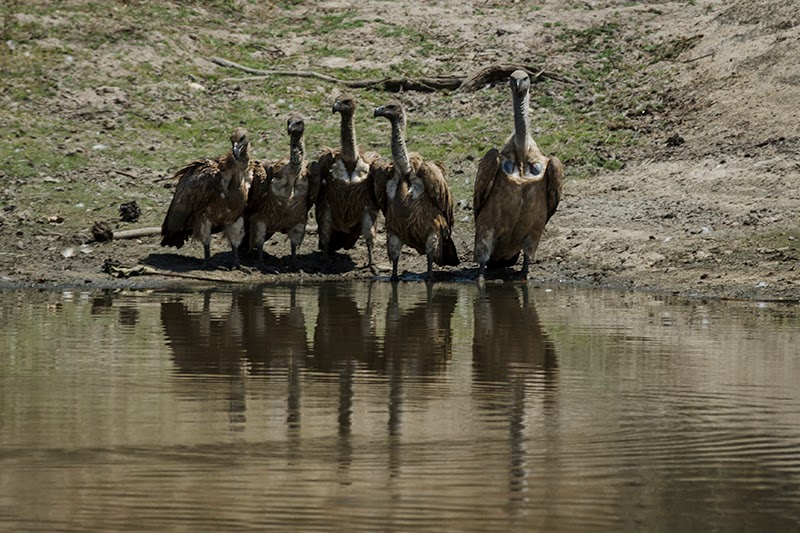
To combat this threat, nature has given us a few select species that specialize in this area.  They are the sanitation team of the bush and they love their job!  The other day we found a dead hippo on the banks of one of the local waterholes.  By the time we arrived on the scene the animal looked as though it had been dead for a few days and not much remained of the amphibious giant but its demise had already benefited a whole host of scavengers.  As we sat in the baking midday heat, the scorching temperatures did not seem to bother the wake of vultures that fought over the remaining scraps of nutrient rich flesh.  With no regard for table manners, they entertained us for ages with their petty squabbling.  Sharp bills stabbed at their fellow dinner guests and wings were spread in anger every few minutes as they tore strips of flesh to store in their crops for digestion later.


We were delighted to see that a large percentage of the raptors present were in fact Cape Vultures.  This species, endemic to southern Africa is considered vulnerable in its status with estimates numbering less than 10,000 left in the world.  Unfortunately, the largest of the vulture family is under threat due to the traditional medicine (or ‘muti’) trade.  Amongst other things, their eyes are especially sought after as they are believed to aid in foresight for the consumer.  Despite their plight, the towering Drakensburg that watch over the Lowveld provides perfect nesting opportunity for this impressive bird and thus, numbers in this area are among the most dense to found anywhere within its range.


Whilst delighting in their meal, they always kept a careful eye on the resident crocodile.  At about 3 meters long, it is not the largest to be found on the reserve but still a formidable adversary should one stray too close to its indiscriminate jaws!  It lay in the shallows next to the carcass occasionally grabbing mouthfuls of decomposing flesh, twisting its streamline body violently to rip off chunks of meat to be swallowed whole.  Such a meal will keep it satiated for months to come no doubt.  Tracks of other scavengers litter the area with both jackal and hyaena spoor found in abundance.

Despite their unsavoury reputation, nature’s clean-up crew perform a vital role within the ecology.  It is incredible to think that a near 2 ton animal can be reduced to pile of bones in only a few days.  The way in which a carcass is systematically dismantled in such a short time is mightily impressive and with the help of the resident sanitation engineers, from hyaena to crocodiles, to vultures, to the humble ants, these vital nutrients will be put back into the soil ready to feed the next generation of organisms.  It is one of many miracles of nature that everything has its place.  Its efficiency is ruthless.  There is almost no role that is not fulfilled in nature and its level of organisation is so far beyond our own self-proclaimed intelligence that our society pales into insignificance in comparison!


Article and photos by Ben Coley